


AI Enterprise Governance
AI enterprise governance is the set of policies, roles, controls, and evidence that decides which AI tools and agents an organization may use, how risk is classified, who is accountable when something fails, and how that accountability is proven to regulators, customers, and boards.
In 2026, AI governance has become an operational priority for many enterprises. The EU AI Act’s Article 50 transparency obligations apply from August 2, 2026, while the Digital Omnibus on AI moved the application of certain high-risk AI requirements to December 2, 2027, and August 2, 2028, depending on how the system is classified. At the same time, enterprises are deploying AI agents that can access business systems and act with increasing autonomy, making inventory, ownership, access control, monitoring, and evidence increasingly important. A company can build excellent AI models and still have weak governance. The two are not the same thing.
This guide covers what the term actually means, three widely used governance reference points (NIST AI RMF, ISO/IEC 42001, and the EU AI Act), the shadow-AI and agentic problems that complicate early programs, a practical starting sequence, and the liability questions organizations need to address.
Do you actually need an AI governance program right now?
There is no single statute titled “AI governance.” Obligations depend on what your systems do, where they are used, and your role in providing or deploying them. If you operate in or sell into the EU, or use AI in regulated or high-impact contexts, you may already have specific obligations under the EU AI Act. Small teams using only low-risk internal tools may need a lighter governance program, but they still carry responsibility for how those systems are used.
Why This Has Become Urgent in 2026
Generative AI has moved from isolated pilots into daily business operations, while autonomous agents are beginning to interact directly with enterprise systems. Gartner has also warned that enterprises need governance approaches that account for differences in agent autonomy and access rather than applying one uniform policy to every agent.
On the regulatory side, EU AI Act Article 50 transparency obligations (labeling AI-generated content, disclosing chatbot interactions) are enforceable now. High-risk obligation were deferred by the Digital Omnibus on AI (Regulation (EU) 2026/1744, Official Journal 24 July 2026): standalone high-risk systems to 2 December 2027, AI embedded in regulated products to 2 August 2028. The delay provides additional implementation time; it does not remove the underlying obligations.
Enterprise AI Governance: NIST AI RMF, ISO/IEC 42001, and the EU AI Act
No single law or standard covers everything, so most organizations combine two or three reference points rather than picking just one.
NIST AI Risk Management Framework (AI RMF). Published by the U.S. National Institute of Standards and Technology in January 2023, the AI RMF is voluntary guidance built around four functions: Govern, Map, Measure, and Manage. It connects AI risk management with accountability, data quality, cybersecurity, human oversight, and other characteristics of trustworthy AI, Because it is voluntary and use-case agnostic, organizations can adapt it to different industries, systems, and risk contexts.
ISO/IEC 42001. This is the world’s first international standard for AI management systems. Unlike the NIST AI RMF, ISO/IEC 42001 is a management-system standard that organizations can implement and seek certification against through an appropriate certification process. The standard covers establishing, implementing, maintaining, and continually improving an AI management system, including processes for managing AI-related risks and opportunities.
The EU AI Act. Unlike the two frameworks above, this is binding law, not voluntary guidance. The EU AI Act can apply to organizations outside the EU when their AI systems are placed on the EU market, put into service in the EU, or their use falls within the Act’s applicable territorial rules. Companies should therefore assess scope based on their role, system, users, and activities rather than assuming location alone determines whether the Act applies.
The table below summarizes how these three fit together, since confusing them is one of the most common mistakes in early-stage governance planning.
| Framework | Type | Legal Status | Certification | Primary Use |
|---|---|---|---|---|
| NIST AI RMF | Voluntary framework | Not legally binding by itself | No | Structuring internal AI risk management |
| ISO/IEC 42001 | Management-system standard | Voluntary adoption | Yes | Establishing a formal AI management system |
| EU AI Act | Regulation | Legally binding where applicable | Not applicable | Meeting applicable EU AI obligations |
What a Governance Program Actually Contains
A governance program is not a single document. In practice, it’s a set of interlocking pieces that answer specific, recurring questions a board or regulator will eventually ask.
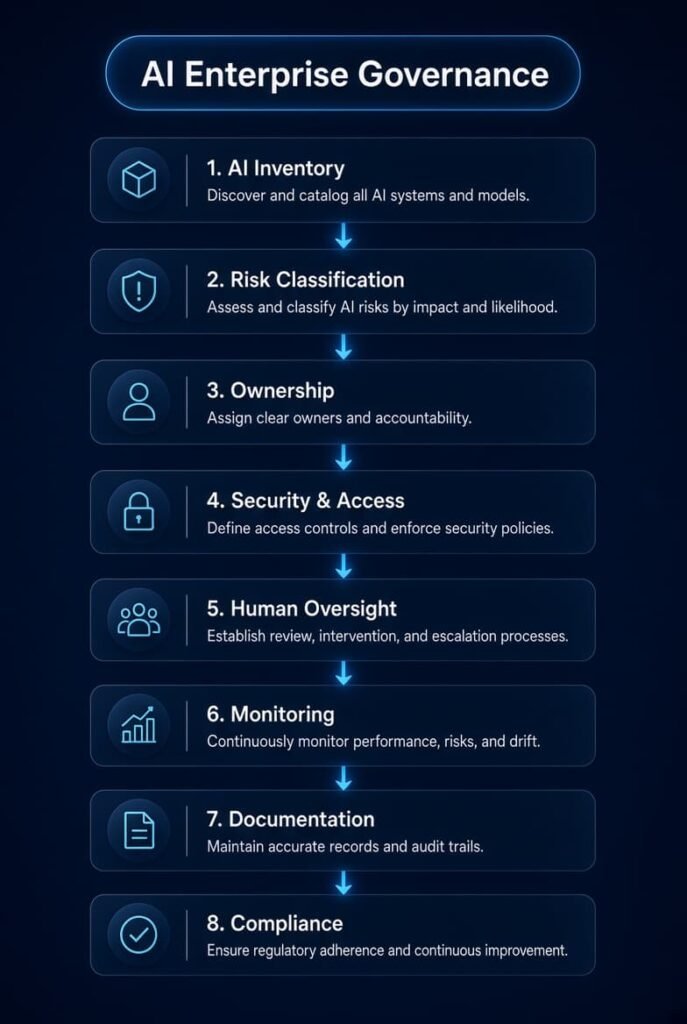
AI system inventory. Before anything else, an organization needs a current list of every AI system in use, including pilots, embedded vendor features, and agents — along with what data each one touches and which business process depends on it. Most companies discover they cannot answer this completely on the first attempt.
Risk classification. Each system gets assessed against a consistent standard (NIST’s functions, the EU AI Act’s tiers, or an internal equivalent) so that effort is proportional to risk. A resume-screening tool and an internal meeting-notes summarizer do not need the same level of scrutiny.
Ownership and escalation. Someone specific — not “the AI team” in the abstract — is accountable for each system, with a defined path for flagging problems and pausing a system if needed.
Technical and human oversight controls. This includes testing for bias and failure modes, monitoring for model drift after deployment, and, for higher-risk systems, a defined point where a human reviews or can override an automated decision.
Evidence and documentation. Regulators and auditors don’t take an organization’s word for it; they expect logs, records of risk assessments, and documentation showing controls actually operated, not just that a policy exists on paper.
Vendor and third-party AI oversight. Most enterprise AI runs on models or platforms the company didn’t build. Governance has to extend to vendor contracts, vendor certifications like ISO 42001, and clarity about which obligations the vendor carries versus which stay with the deploying company — a distinction that matters directly under the EU AI Act, where deployers carry independent obligations regardless of a vendor’s own compliance.
The Shadow AI and Agentic AI Problem
Shadow AI is one of the hardest governance problems because organizations often do not know which AI tools employees are using. Employees may adopt public chatbots, coding assistants, meeting tools, browser extensions, or AI features built into SaaS products without going through a formal review proces. That creates visibility, data-handling, security, and compliance gaps that governance cannot address until the organization knows what is actually being used.
Autonomous AI agents raise the stakes further. Unlike a chatbot a person is actively steering, an agent can chain actions across systems, hold standing API access, and act without a human reviewing each step. The OWASP Top 10 for Agentic Applications, released in December 2025, was one of the first attempts to systematically catalog these risks, covering issues like agents being manipulated into unintended actions and failures that cascade across multiple linked agents.
This becomes more noticeable when a governance program is designed only around known, approved systems. A framework that assumes every AI system went through a review process will miss most of what’s actually running.
Governance vs. No Governance: What Actually Changes
| Without Formal Governance | With Formal Governance | |
|---|---|---|
| System visibility | Unknown number of AI tools and agents in use | Maintained inventory with owners assigned |
| Vendor AI | Adopted ad hoc by business units | Reviewed against a consistent risk standard before adoption |
| Regulatory readiness | Reactive scramble when a deadline or audit hits | Ongoing documentation supports audits as they arise |
| Incident response | Unclear who is accountable or how to pause a system | Defined escalation path and rollback authority |
| Procurement leverage | Limited ability to compare vendors on AI risk | ISO 42001 or equivalent evidence used as a selection criterion |
Common Misconceptions
“Voluntary means optional.” NIST’s framework is voluntary in the sense that no law mandates it directly, but U.S. regulators including the FTC and SEC have referenced NIST-aligned practices in enforcement contexts, and federal contractors increasingly face expectations to show alignment with it. Voluntary frameworks still shape what “reasonable care” looks like when something goes wrong.
“The EU AI Act only applies to EU companies.” Not necessarily. The Act can apply to organizations outside the EU depending on their role, where an AI system is placed on the EU market or put into service, and other territorial-scope conditions. A company’s location alone does not determine whether the Act applies.
“The high-risk deadline delay means we can slow down.” Not entirely. The Digital Omnibus moved the application of certain high-risk AI requirements to December 2, 2027, or August 2, 2028, depending on the system category. Other AI Act provisions have different application dates, including Article 50 transparency obligations from August 2, 2026. Organizations should therefore assess each applicable requirement rather than treating the delay as a blanket postponement.
“Governance is a legal department problem.” In practice it requires input from legal, security, data science, procurement, and the business units actually using the systems. Programs run by legal alone tend to miss shadow AI; programs run by engineering alone tend to miss regulatory nuance.
Who Is Responsible When an AI Agent Causes Harm?
Responsibility for AI-related harm can involve multiple parties, including the AI provider, deployer, vendor, system owner, and other organizations involved in the deployment. Under the EU AI Act, providers and deployers can have different obligations depending on their role and the AI system involved. A company deploying an AI system cannot assume that a model provider’s policies or certifications remove its own responsibilities. Contracts may allocate responsibilities between parties, but organizations still need to understand the legal obligations that apply to them, particularly around risk management, human oversight, transparency, and documentation. For AI agents, clear ownership, access controls, monitoring, and escalation paths are especially important when an agent can access business systems or make consequential decisions.
Where Heavy Governance Isn’t the Right First Step
Not every use case needs a full inventory-to-audit pipeline on day one. A low-risk internal summarizer that never touches external data or automated decisions affecting people can start with a lightweight review. Over-applying heavy controls to pilots slows experimentation and drives teams toward unsanctioned tools — recreating the shadow-AI problem the program was meant to solve. Match review depth to actual risk tier; reserve the heaviest documentation for systems that affect rights, finances, safety, or opportunity.
A Practical Starting Sequence
Organizations starting from scratch can use the following sequence as a practical implementation model, informed by common principles in NIST AI RMF, ISO/IEC 42001, and EU AI Act compliance guidance:
- Inventory every AI system and agent currently in use, including shadow deployments discovered through network and SaaS-usage review.
- Classify each system by risk, using a consistent standard rather than ad hoc judgment.
- Assign an accountable owner and an escalation path for each system above a minimal risk threshold.
- Put baseline controls in place — access restrictions, logging, and a documented review point before deployment.
- Build the evidence trail as you go, rather than trying to reconstruct it later for an audit.
- Review and update the inventory and risk classifications on a recurring schedule, since new tools and agents appear continuously.
Decision Framework: Which Governance Investment Fits Your Situation
| Situation | Reasonable First Move |
|---|---|
| Small team, only internal low-risk AI tools | Lightweight policy + inventory; monitor for scope creep |
| Mid-size company selling into the EU or regulated sectors | NIST-aligned internal program; track EU AI Act risk tiers directly |
| Enterprise handling sensitive personal or financial data at scale | ISO 42001 certification path; dedicated governance function |
| Any organization deploying autonomous agents with system access | Agent-specific controls: identity, least privilege, continuous monitoring — regardless of company size |
Future Trends Worth Watching
AI governance is likely to become more operational as enterprises move from individual AI tools toward systems that can take actions across business applications.
Agent governance will become more important. Organizations will need to govern not only models but also the identities, permissions, tools, APIs, and workflows available to autonomous agents. OWASP’s 2026 Agentic Applications framework reflects this shift toward agent-specific security and control requirements.
AI inventories will become more dynamic. Instead of maintaining a spreadsheet that is updated periodically, mature governance programs are likely to connect AI inventories with procurement, software discovery, identity systems, development pipelines, and monitoring tools.
Governance evidence will become more automated. Risk assessments, approval records, model documentation, monitoring results, and incident records can increasingly be collected as part of normal development and deployment workflows rather than reconstructed for an audit.
AI management systems will also become more formalized. ISO/IEC 42001 provides an established management-system approach for organizations that need a structured way to manage AI risks and opportunities across the organization.
The broader trend is clear: AI governance is moving from a policy document toward an operating layer that connects people, AI systems, data, permissions, and evidence.
Final Thoughts
AI enterprise governance is not a one-time policy exercise. Organizations need to know which AI systems and agents are running, who owns them, what risks they create, and what evidence exists to demonstrate that appropriate controls are operating.
The practical goal is not to slow every AI initiative with the same level of bureaucracy. It is to match governance effort to risk, maintain visibility as AI adoption changes, and make accountability clear before an incident, customer review, audit, or regulatory obligation forces the issue.
FAQs
What’s the difference between AI governance and AI risk management?
AI risk management focuses on identifying, assessing, treating, and monitoring AI-related risks. Governance provides the organization-wide policies, roles, processes, and accountability that make those activities consistent across systems.
Do small and mid-size businesses need to worry about the EU AI Act?
Potentially. Applicability depends on the organization’s role, the AI system, where it is placed on the market or used, and the specific activity involved. Smaller organizations may qualify for certain simplified requirements, but company size alone does not determine whether the Act applies.
Is ISO 42001 certification required by law?
No. It is voluntary, but an increasing number of enterprise buyers request it in procurement as proof of a real AI management system.
What is shadow AI and why does it matter?
AI tools and agents that employees adopt without going through formal IT or security approval. Shadow AI creates visibility, data-handling, security, and compliance gaps because the organization may not know which tools are being used.
How is governing AI agents different from governing a chatbot?
Chatbots stay inside a conversation a human is steering. Agents hold standing access and act independently, so governance centers on identity, least privilege, and continuous monitoring.
Which framework should we adopt first: NIST or ISO 42001?
Start with the free NIST AI RMF to structure the program. Pursue ISO 42001 later if customers or auditors require external certification.
What’s the biggest mistake companies make when starting AI governance?
Designing the program only around approved systems and missing the shadow AI and agents already running.
References
- National Institute of Standards and Technology (NIST). Artificial Intelligence Risk Management Framework (AI RMF 1.0). 2023.
- International Organization for Standardization (ISO). ISO/IEC 42001:2023 — Information technology — Artificial intelligence — Management system. 2023.
- European Commission. AI Act — Regulatory framework for artificial intelligence. European Commission.
- EUR-Lex. Regulation (EU) 2026/1744 — Digital Omnibus on AI. Official Journal of the European Union, 2026.
- OWASP Foundation. OWASP Top 10 for Agentic Applications. 2025–2026.
- NIST. Artificial Intelligence Risk Management Framework: Generative Artificial Intelligence Profile (AI 600-1). 2024.