

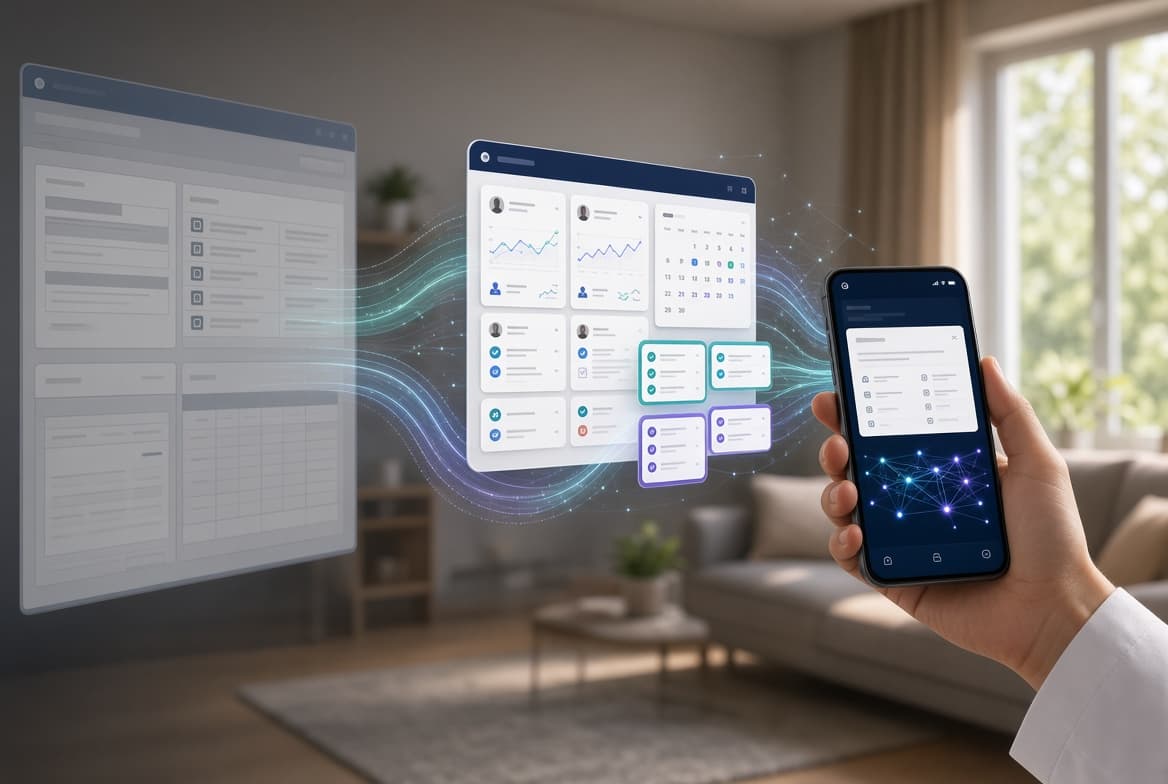
Kinnser Is Now WellSky Home Health: What Changed and What to Know in 2026
If you searched for “Kinnser,” the important update is simple: Kinnser’s home-health software is now sold as WellSky Home Health. WellSky’s current product materials still identify the platform as “formerly Kinnser.”
The change happened in stages. Mediware completed its acquisition of Kinnser Software in June 2017, then rebranded Mediware as WellSky in September 2018.
This guide explains what happened to Kinnser, what WellSky Home Health does in 2026, which AI capabilities have been added, who the platform is designed for, how pricing is handled, and what to check before buying or switching.
Table of Contents
What Is Kinnser?
Kinnser was a web-based healthcare software company founded in 2003. Its products served home health, hospice, therapy, and private-duty care providers, with capabilities covering electronic medical records, revenue cycle management, financial reporting, scheduling, and quality assurance.
Mediware announced its agreement to acquire Kinnser Software in May 2017 and completed the acquisition on June 29, 2017. Mediware then rebranded the company as WellSky in September 2018, bringing Kinnser and more than 30 other healthcare and human-services brands under the WellSky name.
The key distinction: Kinnser was acquired in 2017; the broader Mediware-to-WellSky corporate rebrand happened in 2018. That is why describing Kinnser as simply “rebranded in 2017” is misleading.
The Kinnser-to-WellSky Timeline
| Year | What happened | Why it matters |
|---|---|---|
| 2003 | Kinnser Software was founded | Established the software business that later became part of WellSky |
| 2017 | Mediware agreed to acquire and then completed its acquisition of Kinnser Software | Kinnser became part of Mediware’s healthcare software portfolio |
| Sept. 2018 | Mediware rebranded as WellSky | Kinnser products began moving under the WellSky corporate brand |
| 2018–2019 | WellSky expanded its post-acute and personal-care portfolio through additional acquisitions | Added related capabilities, but not all became part of the Kinnser-derived Home Health product |
| 2026 | WellSky expanded AI capabilities and launched its Point of Care mobile app | Shows how the former Kinnser platform is evolving beyond its original software identity |
Old Kinnser-era web addresses and app listings still appear in the wild. Treat third-party reports of continued use as reported, not officially confirmed by WellSky for every instance.
What WellSky Home Health Does Today
WellSky currently positions Home Health as a web-based EHR and operational platform covering the workflow from referral and intake through care delivery and revenue cycle management. It also supports offline work for clinicians and embeds AI-powered capabilities into several workflows.
Key areas include:
- Referral and intake: Centralized referral management and AI-assisted intake workflows.
- Clinical documentation: Electronic documentation, HIPAA-compliant messaging, and mobile point-of-care workflows.
- Quality assurance: Automatic documentation routing and real-time identification of OASIS issues.
- Revenue cycle: Eligibility, authorizations, billing, accounts receivable, and denial-management capabilities.
- Predictive insights: Patient-level analytics related to hospitalization risk, care-setting suitability, and visit utilization.
- Offline access: Clinicians can continue working when connectivity is limited and synchronize information when connectivity returns.
The important point is that today’s WellSky Home Health is substantially broader than the original Kinnser product. It is better understood as the current WellSky platform that evolved from the Kinnser product line.
What Changed in 2026
The biggest recent changes are concentrated around AI-assisted referral management, clinical documentation, and mobile point-of-care workflows. Because many performance figures come from WellSky’s own analyses or customer examples, they should be treated as vendor-reported results rather than universal outcomes.
| Date | Development | What changed |
|---|---|---|
| Jan. 27, 2026 | AI-powered referral management | WellSky added AI workflows to Enterprise Referral Manager for referral assessment, prioritization, data extraction, and routing with human oversight. |
| May 7, 2026 | WellSky Scribe award | MedTech Breakthrough named WellSky Scribe the winner of its Home Healthcare Innovation Award. |
| May 28, 2026 | WellSky Point of Care app | WellSky launched a native mobile app that brings the patient record and AI-powered workflows onto clinicians’ mobile devices. |
| Aug. 5, 2026 | Scribe analysis | WellSky reported that consistent Scribe users managed 8.6 more patients per month and spent 22% less time on after-hours documentation. |
WellSky Scribe uses ambient listening and transcription to create draft documentation for clinician review. The broader SkySense AI suite also includes medication-extraction capabilities and the WellSky Intelligent Language Assistant (WILA). WellSky says the suite is included for current WellSky Home Health EHR clients at no additional cost, while the Point of Care app brings these capabilities into a mobile workflow.
That does not mean every agency gets identical functionality automatically. Before signing or renewing a contract, confirm which AI features are enabled, which workflows they cover, how generated documentation is reviewed, and how errors are handled.
Does the WellSky name change mean my old Kinnser data disappears?
No general data deletion should be inferred from the branding change itself. Kinnser became part of Mediware in 2017, and the broader company became WellSky in 2018; the current product is still identified by WellSky as formerly Kinnser.
However, the important question for an existing agency is not the name. It is the specific account, contract, integrations, data-retention policy, and export options.
If an agency is moving away from WellSky, the project should be treated as a software migration rather than simply a vendor change. Data extraction, integrations, testing, and cutover planning can all affect the transition.
Before changing systems, confirm in writing:
- Which historical clinical and billing records remain accessible
- Whether existing customizations and templates are supported
- Which integrations will continue to work
- How data can be exported if the agency leaves
- Whether the export includes documents, attachments, signatures, OASIS data, billing records, and metadata
- Which legacy login or application paths remain supported
Do not assume that an old Kinnser URL or login page is an official supported access method. For security, use WellSky’s current website or the access method provided by your agency administrator.
Who It Fits, and Who Should Evaluate Alternatives
| Agency type | Considerations |
|---|---|
| Medicare-certified skilled home health | Strong alignment with home-health clinical, documentation, OASIS, referral, and billing workflows |
| Multi-line organizations | Evaluate how the required WellSky products and modules connect across home health, hospice, or other service lines |
| Non-medical home care | WellSky offers a separate Personal Care product, so buyers should compare that product rather than assume the Home Health platform is designed for non-medical care |
| Smaller therapy or contractor groups | Evaluate actual patient volume, documentation requirements, payer mix, integrations, and staffing workflows before choosing |
Strengths and Limitations
What users like: Current Capterra reviews include positive comments about ease of use, compliance-related workflows, and ongoing product development. Capterra currently lists WellSky Home Health at 3.4 out of 5 from 108 reviews, with an ease-of-use score of 3.8 and customer-service score of 3.2.
What users criticize: Reviews are mixed. Some users report frustration with customer support and unresolved issues, while others describe positive experiences with the platform and its newer capabilities. That makes agency-specific references more useful than relying on an aggregate score alone.
Pricing is opaque: WellSky does not publish a standard list price for Home Health. Current software directories direct buyers to contact the vendor for pricing, so agencies should request a written quote that itemizes users, modules, implementation, integrations, AI features, and support.
AI tools are evolving quickly: WellSky has expanded Scribe, SkySense AI, referral automation, and the Point of Care app during 2026. Buyers should confirm exactly which features are included in their contract and how AI-generated documentation is reviewed before it enters the patient record.
The 2026 Payment Backdrop
CMS issued the CY 2027 Home Health Prospective Payment System proposed rule on July 1, 2026. The proposal estimated a 2.4% increase in aggregate Medicare payments to home health agencies for 2027, or about $420 million, compared with CY 2026.
As of September 30, 2026, the CY 2027 final rule had been submitted to the Office of Management and Budget for review on September 21. That means the July proposal should not be treated as the final 2027 payment policy yet.
For software buyers, the practical takeaway is less about predicting the final payment rate and more about understanding how documentation, OASIS, billing, eligibility, authorization, and revenue-cycle workflows affect agency operations as reimbursement rules change.
Logging In
Use WellSky’s official website or the login method provided by your agency administrator. Avoid searching for old Kinnser login pages and entering credentials into unfamiliar domains.
Healthcare software accounts can contain sensitive patient information, so verify the domain before signing in and use your organization’s approved authentication process.
If you have forgotten your credentials, contact your agency administrator or WellSky’s official support channel rather than relying on an old Kinnser-era login link.
Alternatives Worth Shortlisting
Common alternatives in the home-health software market include Homecare Homebase (HCHB), Alora, KanTime, and AlayaCare.
The right comparison depends on your payer mix, service lines, state EVV requirements, clinician workflows, billing processes, integrations, and data-export requirements.
For an agency considering a move away from Kinnser/WellSky, compare complete workflows rather than feature lists. A platform that looks better in a demo may still create migration or billing problems if it handles your existing data, integrations, and documentation processes differently. For larger agencies replacing a legacy platform, the project can also become part of a broader IT modernization effort.
A Practical Checklist Before You Buy or Switch
- Get a written quote that itemizes AI tools, mobile apps, billing connections, implementation, and support.
- Request references from agencies with similar service lines, payer mix, and census.
- Test offline charting in your worst-signal service area.
- Ask how signed documents and attachments are stored, backed up, and recovered if something fails.
- Confirm how OASIS and other clinical documentation workflows are handled.
- Test your critical billing and payer workflows before committing.
- Ask which AI features are included and whether they require separate enrollment or activation.
- Ask how AI-generated documentation is reviewed, corrected, and retained.
- Plan any cutover between billing cycles.
- Obtain detailed data-export terms before signing.
- Request a sample export containing representative clinical documents, attachments, and structured data.
FAQs
Is Kinnser the same as WellSky?
Kinnser’s home-health software is now sold as WellSky Home Health. The broader corporate rebrand from Mediware to WellSky occurred in 2018.
What is Kinnser Agency Manager called now?
It is now part of WellSky Home Health, which WellSky identifies as formerly Kinnser.
Who owns Kinnser?
Kinnser was acquired by Mediware in 2017. Mediware subsequently became WellSky in 2018.
Is Kinnser still supported?
The Kinnser name is no longer the current product brand for home health. WellSky continues to sell and support WellSky Home Health, which it identifies as formerly Kinnser.
How much does Kinnser cost?
WellSky does not publish a standard list price. Third-party sites currently cite starting figures around $50 per user per month, but agencies should request an official quote.
Does WellSky Home Health have AI?
Yes. Current capabilities include WellSky Scribe, SkySense AI, AI-powered referral management, and the WellSky Point of Care mobile app.
Is Kinnser suitable for non-medical home care?
The former Kinnser home-health product is aimed at skilled home health. WellSky offers separate Personal Care software for non-medical home care.
Can I still use an old Kinnser login?
Do not assume that an old Kinnser-era URL is an officially supported login method. Use the access method supplied by your agency administrator or WellSky.
References
- WellSky — WellSky Home Health software, current product capabilities and “formerly Kinnser” positioning.
- TPG Capital — Mediware Completes Acquisition of Kinnser Software, June 29, 2017.
- WellSky — 2018 announcement introducing the WellSky corporate brand.
- WellSky — WellSky Scribe and SkySense AI materials.
- WellSky — WellSky Point of Care app for Home Health.
- WellSky — January 2026 AI-powered referral management announcement.
- Capterra — WellSky Home Health user reviews, updated September 2026.
- CMS — CY 2027 Home Health Prospective Payment System proposed rule, CMS-1844-P.
- CMS — Home Health Prospective Payment System regulations and notices.