
Convergence vs Hyperconvergence in Cybersecurity: What Actually Changes
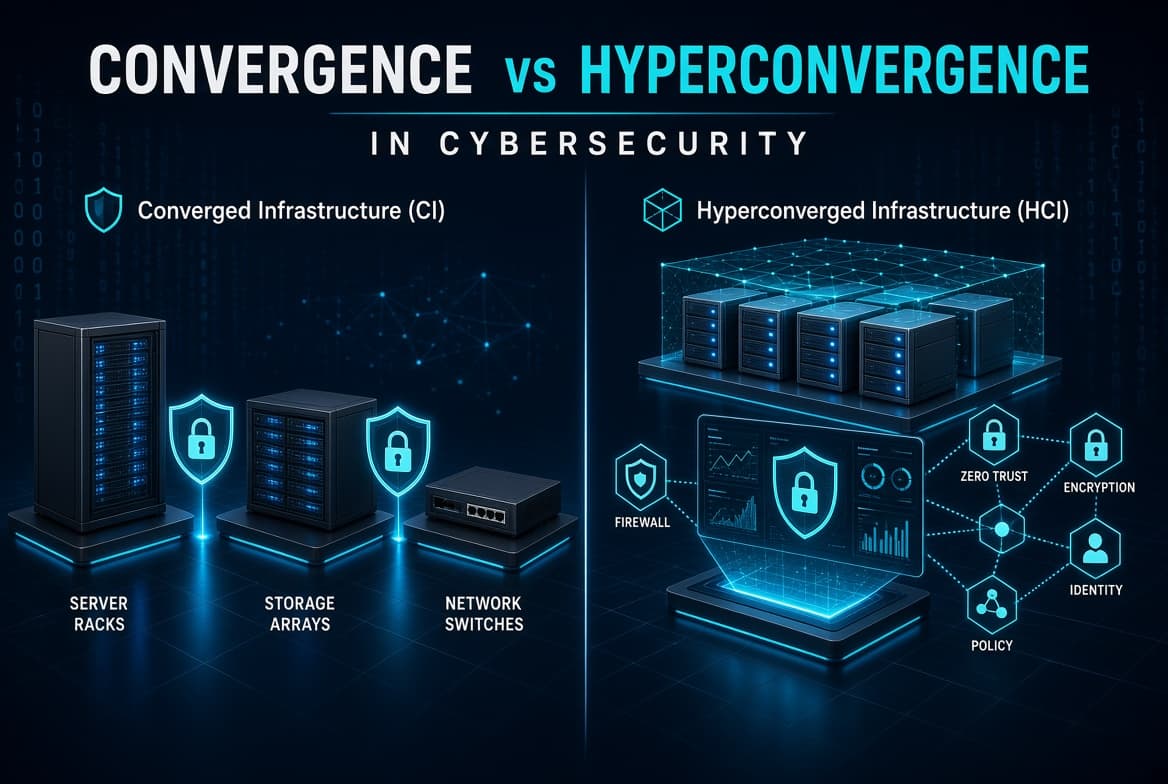
Convergence and hyperconvergence sound like two flavors of the same idea, but in cybersecurity terms they put your protection in different places. Converged infrastructure (CI) keeps servers, storage, and networking as separate physical components, each with its own boundary. Hyperconverged infrastructure (HCI) dissolves those boundaries into a single software-defined layer, managed from one console. That’s the actual difference between convergence and hyperconvergence in regards to cybersecurity: not which one has more features, but where your security boundaries live and who’s responsible for maintaining them.
This isn’t an academic distinction. It decides how far a breach can spread, which security tools can actually see what’s happening inside your environment, and how fast your team recovers after an incident. Anyone comparing CI and HCI for a data center refresh, a disaster recovery rebuild, or a security audit runs into this trade-off immediately. The choice also affects how teams approach broader IT infrastructure management, including monitoring, automation, security controls, and operational governance.
Table of Contents
What Convergence and Hyperconvergence Mean, in Plain Terms
Converged Infrastructure (CI)
Converged infrastructure packages compute, storage, and networking hardware from one or more vendors into a pre-engineered bundle, often sold as a single SKU (Dell VxBlock and NetApp FlexPod are common examples). The components are designed to work together, but they remain physically distinct and are typically managed through separate consoles — one for storage, one for networking one for compute.
Hyperconverged Infrastructure (HCI)
Hyperconverged infrastructure takes that idea further. Instead of physical storage arrays and dedicated network appliances, HCI uses a software layer, usually running at or near the hypervisor, to virtualize storage and networking directly on standard x86 servers. IBM describes this as replacing specialized, separately managed hardware with virtualized components run through a unified software layer. Examples include Nutanix Cloud Platform, Dell VxRail, VMware vSAN, and Microsoft Azure Local.
CI and HCI solve a similar infrastructure-integration problem, but they do so at different architectural layers. CI integrates physical components into a pre-engineered system, while HCI moves more of that integration into software.
The Core Technical Difference
| Attribute | Converged Infrastructure (CI) | Hyperconverged Infrastructure (HCI) |
|---|---|---|
| Component integration | Pre-engineered physical compute, storage, and networking components | Compute, storage, and networking are abstracted and managed through software |
| Management | May involve separate tools for different infrastructure components | Typically provides more centralized management |
| Scaling | Components can often be scaled independently | Commonly scales by adding integrated nodes, although architectures vary |
| Underlying infrastructure | Uses specialized or purpose-built hardware components | Commonly uses standardized x86 servers with software-defined infrastructure |
| Resource flexibility | Greater ability to separate or replace components | Resources are more tightly integrated and pooled |
| Main operational trade-off | More component-level coordination | Greater dependence on the software and management layer |
What Is the Difference Between Convergence and Hyperconvergence in Regards to Cybersecurity?
The security difference between converged and hyperconverged infrastructure is less about one architecture being inherently safer and more about where security controls, management access, and monitoring have to be enforced.
In converged infrastructure, compute, storage, and networking remain distinct components even though they are engineered and deployed as an integrated system. This can make existing security tools and team responsibilities easier to map to individual infrastructure layers. However, physcal separation does not automatically create secure segmentation; access controls, network policies, monitoring, and administrative protections still have to be configured correctly.
In hyperconverged infrastructure, compute, storage, and networking are abstracted through software and managed as a more integrated platform. That can simplify administration and provide centralized visibility, but it also makes the hypervisor, management plane, identity controls, and virtual networking important security boundaries.
NIST’s virtualization guidance emphasizes security concerns involving virtualization technologies, while its hypervisor guidance addresses secure hypervisor deployment, administration, virtual networks, and monitoring. NIST’s Zero Trust guidance also recommends protecting resources rather than assuming that physical or network location provides implicit trust.
The practical takeaway: CI does not automatically create better security, and HCI does not automatically create a larger vulnerability. The security outcome depends on how each environment is segmented, administered, monitored, and recovered.
Where the Security Difference Actually Appears
The security difference between converged and hyperconverged infrastructure is less about one architecture being inherently safer and more about where security controls, management access, and monitoring have to be enforced.
In converged infrastructure, compute, storage, and networking remain distinct components even though they are engineered and deployed as an integrated system. This can make existing security tools and team responsibilities easier to map to individual infrastructure layers. However, physical separation does not automatically create secure segmentation; access controls, network policies, monitoring, and administrative protections still have to be configured correctly.
In hyperconverged infrastructure, compute, storage, and networking are abstracted through software and managed as a more integrated platform. That can simplify administration and provide centralized visibility, but it also makes the hypervisor, management plane, identity controls, and virtual networking important security boundaries.
NIST’s virtualization guidance emphasizes protecting the hypervisor, administrative interfaces, virtual networks, and other components of the virtualization environment. Its Zero Trust guidance also recommends protecting individual resources rather than assuming that physical or network location provides implicit trust.
The practical takeaway: CI does not automatically create better security, and HCI does not automatically create a larger vulnerability. The security outcome depends on how each environment is segmented, administered, monitored, and recovered.
Where Hyperconverged Infrastructure Can Have a Security Advantage
HCI can simplify security operations by bringing more infrastructure functions under a common management layer. A centralized interface can make it easier to apply consistent policies, review infrastructure activity, and automate administrative tasks.
That does not automatically mean better security. The benefit depends on whether the management platform provides adequate logging, role-based access control, integration with security tools, and visibility into virtual networking and workloads.
Where Converged Infrastructure Falls Short
The trade-off is operational complexity. Multiple consoles mean multiple places for policies to drift out of sync, and multiple teams (storage admins, network admins, security) often have to coordinate on a single change. That coordination overhead is itself a security risk: manual, cross-team processes are where misconfigurations creep in.
The Security Risks That Come With Hyperconvergence
HCI concentrates more infrastructure functions into a software-defined platform, so privileged access to the hypervisor, management interfaces, identity systems, and virtual networking deserves particular attention.
A compromise of a highly privileged management component can have significant consequences, but the actual blast radius depends on the platform’s isolation, access controls, segmentation, workload architecture, and recovery design.
Several security considerations therefore deserve attention when deploying HCI:
- Visibility gaps. Security tools designed around physical network, compute, or storage boundaries may not provide the same visibility into virtualized infrastructure. NIST specifically identifies virtual-network segmentation, traffic control, and VM traffic monitoring as important security considerations.
- Misconfiguration. HCI shifts more infrastructure control into software, making configuration, identity, privilege, and policy management especially important.
- Shared software dependencies. A vulnerability affecting a common hypervisor, management platform, or software-defined networking component can affect multiple workloads, depending on the architecture and exposure.
- Insufficient segmentation. Centralized infrastructure does not eliminate the need for network segmentation, least-privilege access, workload isolation, and appropriate monitoring.
None of this means HCI is inherently less secure than CI. It means the security model has to be rebuilt around software boundaries instead of physical ones, and that rebuild doesn’t happen automatically just because the hardware changed.
Security Considerations Side by Side
| Consideration | Converged Infrastructure | Hyperconverged Infrastructure |
|---|---|---|
| Security boundaries | More visibly aligned with separate infrastructure components | More dependent on software, identity, and virtual-network controls |
| Management | May require coordination across infrastructure tools | Typically more centralized |
| Visibility | Often distributed across infrastructure layers | Can be centralized, depending on platform and security-tool integration |
| Main security focus | Consistent controls across separate components | Protecting management, hypervisor, virtual networking, and workload layers |
| Potential blast radius | Depends on component isolation and network architecture | Depends heavily on management access, segmentation, and shared infrastructure components |
| Recovery | May involve separate infrastructure components | Can benefit from integrated automation and recovery features |
| Main operational challenge | Coordinating policies and teams | Protecting centralized management and software-defined infrastructure |
Security Is Not the Same as Architecture
Neither CI nor HCI provides security simply because of how its components are packaged.
A CI environment can be poorly secured if administrative accounts are overprivileged, network segmentation is weak, systems are unpatched, or monitoring is incomplete. An HCI environment can also be well secured when the hypervisor, management plane, identity controls, virtual networks, workloads, and recovery systems are properly protected.
The more useful question is therefore not “Which architecture is more secure?” but “Which architecture can our team secure consistently with the controls, skills, tooling, and operational processes we already have?”
Securing Each Model in Practice
For CI, the priority is closing the coordination gap: consistent policy enforcement across the separate consoles, and clear ownership so a network change doesn’t quietly bypass a storage-level control.
For HCI, the security priorities center on protecting the hypervisor, management plane, virtual networks, workloads, and administrative access.
- Apply Zero Trust principles. Use identity-based authentication and authorization rather than assuming that users, devices, or workloads are trusted because they are inside the infrastructure environment.
- Harden the hypervisor and virtualization platform. Protect administrative access, keep the virtualization stack updated, and apply secure configuration practices based on the platform’s security guidance. NIST SP 800-125A Rev. 1 specifically addresses secure hypervisor deployment and management.
- Apply encryption and access controls at the workload and data level where appropriate rather than relying only on platform-wide controls.
- Verify your security tools are actually HCI-aware; tools built for siloed infrastructure don’t always extend cleanly into a pooled one.
- Keep backup and recovery snapshots logically isolated from the production management plane.
A Simple Way to Decide Which Fits Your Environment
Choose converged infrastructure if:
- You want infrastructure components to remain more independently replaceable or upgradeable.
- Your teams already have established processes for managing compute, storage, and networking separately.
- Your security or operational requirements favor greater component-level separation.
Choose hyperconverged infrastructure if:
- Your organization is prepared to invest in HCI-aware monitoring, identity, and security controls.
- Your team can adequately secure and manage the centralized software and virtualization layers.
- You want more centralized infrastructure management and automation.
- Your workloads fit a node-based or software-defined infrastructure model.
Neither list means “more secure.” It means less work to get security right with one, and less operational overhead with the other.
Common Misunderstandings Worth Correcting
“Hyperconvergence is automatically more secure because it is newer.”
No. HCI changes where security controls are applied; newer architecture does not automatically mean stronger security.
“Converged infrastructure is secure because its components are physically separate.”
Not necessarily. CI still depends on proper identity, segmentation, configuration, patching, and monitoring.
“One management console always reduces security risk.”
Centralized management can improve consistency and visibility, but it can also make privileged access to the management plane especially important.
Final Thoughts
Convergence and hyperconvergence aren’t a simple security upgrade path. They are different approaches to integrating infrastructure, and each changes where security controls, management access, and operational responsibilities sit.
CI keeps infrastructure components more visibly distinct, which can fit organizations with established component-level processes and tooling. HCI brings more infrastructure functions into a software-defined management model, which can simplify operations while making the hypervisor, management plane, identity controls, and virtual networking especially important security considerations.
The better choice isn’t the architecture that sounds more secure. It’s the one your team can secure, monitor, maintain, and recover consistently.
FAQs
Is hyperconverged infrastructure less secure than converged infrastructure?
Not inherently. HCI changes the security boundaries and makes the hypervisor, management plane, identity controls, and virtual networking especially important.
What is the main difference between convergence and hyperconvergence?
CI integrates physical compute, storage, and networking components, while HCI uses software-defined infrastructure to virtualize and pool those resources.
Can existing security tools protect a hyperconverged environment?
Yes, but coverage depends on the platform and tools. Organizations should verify visibility into the hypervisor, virtual networks, workloads, management plane, and logs.
Does moving to hyperconverged infrastructure increase ransomware risk?
Not automatically. However, a compromised privileged management account or shared infrastructure component can increase the potential impact of an incident.
What is a converged infrastructure example?
Dell VxBlock and NetApp FlexPod are examples of converged infrastructure platforms.
What is a hyperconverged infrastructure example?
Examples include Nutanix Cloud Platform, Dell VxRail, and Microsoft Azure Local.
Do I need Zero Trust principles for hyperconverged infrastructure?
Zero Trust principles can strengthen HCI security by requiring explicit authentication and authorization rather than relying on network location or infrastructure boundaries.
Why do IT teams worry about security when adopting hyperconverged infrastructure?
The main concerns include privileged management access, hypervisor security, virtual-network visibility, configuration errors, and protecting shared infrastructure components.
References
- IBM. What Is Hyperconverged Infrastructure? IBM Think.
- National Institute of Standards and Technology. Guide to Security for Full Virtualization Technologies (SP 800-125).
- National Institute of Standards and Technology. Security Recommendations for Server-based Hypervisor Platforms (SP 800-125A Rev. 1).
- National Institute of Standards and Technology. Zero Trust Architecture (SP 800-207).
- National Institute of Standards and Technology. Secure Virtual Network Configuration for Virtual Machine (VM) Protection (SP 800-125B).
- Microsoft. Azure Local Security Book.