
IT Infrastructure Management: What It Involves, Tools & Best Practices
IT infrastructure management is the ongoing process of operating, maintaining, securing, and improving the technology foundation a business depends on. That foundation can include servers, storage, networks, endpoints, operating systems, data centers, cloud resources, and the tools used to monitor and control them.
The work goes beyond keeping systems online. Infrastructure teams also plan capacity, apply patches, manage configurations, control cloud spending, maintain backups, monitor performance, and respond to failures. In a hybrid environment, they may have to manage on-premises systems and several cloud services at the same time.
That makes infrastructure management a continuous operational discipline rather than a single software product. The goal is to keep technology reliable and secure while making changes predictable enough that the environment can grow without becoming harder to operate.
Table of Contents
What IT Infrastructure Management Actually Means
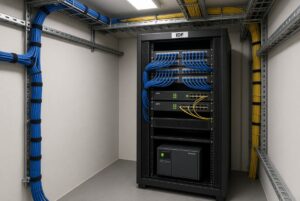
At its core, IT infrastructure management is the administration of the physical and virtual components that let an organization deliver technology services: servers, storage, networking gear, operating systems, applications, and the data centers or cloud regions that house them. It typically breaks down into three overlapping disciplines, systems management, storage management, and network management, with security and cost control running through all three.
The goal isn’t just keeping the lights on. Done well, infrastructure management is what lets a company scale during a busy season, recover quickly after a hardware failure, and avoid the slow performance decay that frustrates employees and customers long before anything technically breaks.
The Core Components
Most infrastructure management programs organize around five categories of assets.
Core IT Infrastructure Components
| Component | What It Includes | Primary Management Focus |
|---|---|---|
| Hardware | Servers, workstations, storage arrays, backup units | Lifecycle planning, capacity, physical security |
| Software | Operating systems, applications, middleware | Licensing, patching, version control |
| Network | Routers, switches, firewalls, SD-WAN | Uptime, segmentation, traffic monitoring |
| Data centers & facilities | Power, cooling, physical access control | Redundancy, disaster recovery |
| Cloud services | IaaS, PaaS, SaaS platforms | Cost governance, configuration, access control |
Where IT Infrastructure Management Fits in ITIL
ITIL provides a service-management framework that helps organizations organize how technology services are designed, delivered, operated, and improved. Infrastructure management sits within this broader service-management environment rather than operating as a completely separate discipline.
In ITIL 4, Infrastructure and Platform Management is one of the technical management practices. Related practices such as monitoring and event management, IT asset management, service configuration management, capacity and performance management, and information security management also affect infrastructure operations.
ITIL (Version 5) launched in February 2026 and expands its focus on digital product and service management, with stronger attention to AI and modern digital practices. For infrastructure teams, the practical takeaway is simple: use ITIL as a framework for organizing responsibilities, controls, and service outcomes rather than treating it as a checklist of processes.
On-Premises, Cloud, Hybrid, and Hyperconverged
Every organization eventually has to decide where its workloads live. There are four broad models, and most companies of any size end up running more than one.
Infrastructure Deployment Models Compared
| Model | Control | Typical Use Case | Main Trade-off |
|---|---|---|---|
| On-premises | Full control over hardware and data | Regulated workloads, legacy systems | High capital cost, slower to scale |
| Public cloud | Provider manages hardware | Variable or growing workloads | Recurring cost, less low-level control |
| Hybrid | Mix of owned and rented infrastructure | Sensitive data paired with cloud-based apps | Integration and tooling complexity |
| Hyperconverged | Compute, storage, networking combined in one system | Simplifying smaller data centers | Vendor lock-in risk |
Flexera’s 2026 State of the Cloud report found that 73% of organizations surveyed operate hybrid cloud environments. That helps explain why infrastructure management is becoming more complex: teams increasingly have to maintain consistent visibility, security policies, configuration standards, and cost controls across environments that use different platforms and tools. Infrastructure decisions are also closely connected to broader IT modernization efforts, particularly when organizations are replacing legacy systems, consolidating infrastructure, or deciding which workloads should remain on-premises and which should move to cloud environments.
Infrastructure as Code and Automation
One of the more significant shifts in infrastructure management has been the move away from manually configuring servers toward defining infrastructure in code. Amazon Web Services describes infrastructure as code (IaC) as the ability to provision and manage computing infrastructure through machine-readable definition files rather than manual processes, letting teams recreate an entire environment in minutes instead of days.
The appeal isn’t only speed. Version-controlled infrastructure creates an audit trail: if a security reviewer asks who changed a network rule or when encryption was enabled, the answer lives in a code repository rather than someone’s memory. Common IaC options include Terraform, AWS CloudFormation, Azure Bicep, and other configuration-driven tools, though the right choice usually depends on which cloud provider a company relies on most. IaC doesn’t remove the need for human oversight, a flawed template can misconfigure a hundred servers as easily as it can configure them correctly, but it does make infrastructure changes repeatable and reviewable in a way manual processes rarely allow.
Common IT Infrastructure Management Tools
IT infrastructure management rarely depends on one platform. Many organizations use a combination of tools for monitoring, configuration, asset management, automation, security, and service management.
| Tool Category | What It Helps Manage | Examples |
|---|---|---|
| Infrastructure monitoring | Servers, networks, storage, cloud resources | Datadog, Zabbix, SolarWinds, New Relic |
| IT service management (ITSM) | Incidents, service requests, changes, workflows | ServiceNow, Jira Service Management, Freshservice |
| RMM and endpoint management | Endpoints, servers, patching, remote administration | NinjaOne, Datto RMM, Atera |
| Configuration and IaC | Infrastructure configuration and repeatable provisioning | Terraform, Ansible, AWS CloudFormation, Azure Bicep |
| CMDB and asset management | Configuration items, ownership, relationships, lifecycle data | ServiceNow CMDB, Device42, ManageEngine |
| Cloud management and FinOps | Cloud usage, cost, governance, optimization | AWS tools, Azure management tools, Google Cloud tools, FinOps platforms |
| Backup and disaster recovery | Data protection and recovery operations | Veeam, Acronis, Commvault |
The right combination depends on the environment. A small SaaS-based company may need little more than cloud-native monitoring, endpoint management, backup, and security tools. A large hybrid enterprise may also need ITSM, CMDB, service mapping, configuration management, observability, and dedicated cloud-cost governance.
The important question is not how many tools an IT team can deploy. It is whether those tools share enough information to give the team reliable visibility into infrastructure health, dependencies, changes, security, and cost.
Monitoring, Observability, and the AIOps Question
Modern infrastructure generates more telemetry than an operations team can review manually. Monitoring and observability platforms such as Datadog, Splunk, SolarWinds, Zabbix, and New Relic help teams collect and analyze metrics, logs, traces, and events.
AIOps adds analytics and machine-learning techniques to this operational data to help correlate events, detect anomalies, reduce alert noise, and identify likely causes. The terminology is changing, however. Gartner’s 2025 research uses the term Event Intelligence Solutions, while other vendors and analysts continue to use AIOps.
For organizations evaluating these tools, the label matters less than the capability: can the platform correlate events across systems, identify meaningful anomalies, provide useful context, and support an appropriate response?
Security Considerations
Infrastructure management and cybersecurity are closely connected because infrastructure teams control many of the systems, configurations, access paths, and recovery mechanisms that security teams depend on.
The NIST Cybersecurity Framework 2.0 organizes cybersecurity risk management around six Functions: Govern, Identify, Protect, Detect, Respond, and Recover. The framework is voluntary and can be used by organizations of different sizes and industries.
For infrastructure teams, practical priorities include:
- Maintaining supported software and regular patching cycles
- Applying least-privilege access controls
- Segmenting networks where appropriate
- Monitoring infrastructure and security events
- Protecting backups from unauthorized access
- Testing backup and recovery procedures
- Reviewing cloud and infrastructure configurations regularly
In hybrid environments, these controls need to work across both on-premises and cloud resources rather than being managed as separate security islands.
Common Challenges
Downtime and availability
Infrastructure failures can become expensive quickly when they affect revenue-generating or business-critical services. ITIC’s 2024 survey found that more than 90% of mid-size and large enterprises surveyed estimated the average cost of an hour of downtime at more than $300,000. The figure is an industry survey result, not a universal cost benchmark, so organizations should calculate their own business impact when setting availability and recovery targets.
Skills and operational complexity
Modern infrastructure requires a combination of networking, cloud, automation, security, monitoring, and troubleshooting skills. Smaller teams may struggle to maintain all of these capabilities internally, which is one reason organizations sometimes use managed service providers or specialized consultants.
Tool sprawl
Another problem is the growing number of separate tools used to monitor, secure, configure, and manage infrastructure. Each platform can create its own alerts, dashboards, credentials, and operating procedures. Without integration and clear ownership, adding more tools can increase operational complexity rather than reduce it.
When Heavy Infrastructure Management Isn’t Necessary
Not every organization needs a large infrastructure team or a complex management platform.
A small business that relies heavily on SaaS applications, has little on-premises infrastructure, and has modest operational requirements may get more value from a managed service provider and built-in cloud or SaaS administration tools.
The decision should depend on factors such as uptime requirements, infrastructure complexity, regulatory obligations, data sensitivity, internal expertise, and the amount of hands-on administration required. As those demands increase, dedicated infrastructure management capabilities become easier to justify.
Common Misconceptions
A frequent misunderstanding is that moving to the cloud eliminates infrastructure management rather than changing its shape — cloud environments still need monitoring, cost governance, and security configuration; the work shifts from racking servers to managing consumption and access. Another is treating AIOps or automation tools as a replacement for skilled staff rather than a way to reduce repetitive work so people can focus on harder problems. A third is assuming on-premises infrastructure is inherently more secure than cloud infrastructure; in practice, security outcomes depend far more on how well either environment is configured and maintained than on where the hardware physically sits.
Future Trends
One of the more interesting directions in infrastructure management is the move from AI-assisted monitoring toward agentic IT operations. Instead of simply detecting an anomaly or correlating alerts, an AI agent could investigate an incident, gather telemetry, identify a likely cause, and recommend or perform a remediation.
Research such as Microsoft’s AIOpsLab shows that this is being evaluated as an engineering problem rather than simply a marketing concept. The framework tests AI agents on operational tasks including fault detection, localization, root-cause analysis, and mitigation in cloud environments.
That does not mean fully autonomous infrastructure operations are already standard. Production environments still need controls around permissions, validation, auditability, and human approval for high-impact actions. The more realistic near-term role for AI is to reduce repetitive investigation and remediation work while keeping humans responsible for consequential changes.
Two other trends are already affecting infrastructure planning. AI workloads are increasing demand for high-performance compute and data-center capacity, while FinOps is becoming increasingly important as organizations manage cloud consumption across multiple environments. Flexera’s 2026 State of the Cloud report also highlights the continued dominance of hybrid cloud and the growing need for governance and cost visibility.
A Simple Decision Framework
When deciding how to evolve an infrastructure strategy, it helps to work through a short set of questions rather than defaulting to whatever a vendor pitched most recently.
Infrastructure Decision Framework
| Question | If Yes | If No |
|---|---|---|
| Do workloads have strict data residency or regulatory requirements? | Evaluate approved cloud regions, private infrastructure, and hybrid options against the specific requirement | More deployment options may be available |
| Does workload demand fluctuate significantly? | Evaluate cloud elasticity or a hybrid model | Compare predictable infrastructure costs with operational requirements |
| Is in-house infrastructure expertise limited? | Consider managed services or additional specialist support | Internal management may be practical |
| Are workloads highly sensitive to network latency? | Evaluate edge, local, or strategically placed infrastructure | Centralized cloud or on-premises deployment may be sufficient |
How Do You Know If IT Infrastructure Management Is Working?
A useful infrastructure program should be measurable. The exact targets depend on the business, but a small set of operational metrics can show whether the environment is becoming more reliable and easier to manage.
- Availability and SLO attainment — whether critical services meet their agreed reliability targets.
- MTTR (Mean Time to Recovery) — how quickly the team restores service after an incident.
- Patch compliance — the percentage of systems meeting the organization’s patching requirements.
- Change failure rate — the percentage of infrastructure changes that result in incidents, rollbacks, or other operational problems.
- Backup and recovery success — whether backups complete successfully and recovery tests meet their objectives.
- Cost per workload — whether infrastructure spending is reasonable relative to the workload’s usage and business value.
- Alert quality — how many alerts require meaningful investigation rather than being ignored as noise.
There is no single “good” number for every organization. A payment platform, manufacturing environment, and small office will have very different availability, recovery, and cost requirements. The important thing is to define targets for critical services and track them consistently.
IT Infrastructure Management Best Practices
Effective infrastructure management is less about buying more tools and more about establishing repeatable operating practices.
- Maintain an accurate asset inventory so teams know what systems, devices, services, and dependencies they are responsible for.
- Standardize configurations to reduce differences between environments and make troubleshooting easier.
- Automate repeatable changes with Infrastructure as Code, configuration management, and approved deployment workflows.
- Patch according to risk and policy rather than treating every system identically.
- Test backups and recovery procedures instead of assuming a successful backup job guarantees recoverability.
- Monitor critical dependencies across networks, applications, cloud resources, and infrastructure rather than looking at isolated systems.
- Control administrative access through least privilege, strong authentication, and regular access reviews.
- Review infrastructure costs regularly so unused resources and unexpected consumption do not become permanent expenses.
- Document important architecture and operational decisions so infrastructure knowledge does not remain with one person or one team.
The goal is not to eliminate every infrastructure problem. It is to make the environment predictable enough that problems can be detected early, changes can be reviewed, and recovery does not depend on improvisation.
Final Thoughts
IT infrastructure management doesn’t have a finish line — it’s a running trade-off between reliability, security, and cost, made harder by the fact that the underlying environment keeps changing shape. The difference is usually less glamorous: strong teams document important decisions, automate repeatable work without removing human oversight, and review their architecture before problems force a change.
FAQs
What is the difference between IT infrastructure and IT infrastructure management?
IT infrastructure is the technology environment itself. Infrastructure management is the ongoing work of operating, securing, monitoring, maintaining, and improving that environment.
Is IT infrastructure management the same as IT operations?
Not exactly. Infrastructure management focuses on the technology foundation, while IT operations is broader and can include service management, incident handling, user support, and other operational activities.
What tools are used for IT infrastructure management?
Common categories include infrastructure monitoring, ITSM, RMM, configuration management, Infrastructure as Code, CMDB, cloud management, FinOps, backup, and security tools.
What skills are needed for IT infrastructure management?
Common skills include networking, operating systems, cloud platforms, automation and scripting, monitoring, troubleshooting, security, and configuration management.
How much does IT infrastructure management cost?
There is no universal price. Cost depends on infrastructure size, cloud usage, number of devices, staffing model, security requirements, support coverage, and whether the organization uses managed services.
Do small businesses need infrastructure management software?
Not always. Smaller businesses can often start with built-in cloud, endpoint, backup, and security tools before investing in a larger infrastructure-management platform.
What is the biggest challenge in hybrid cloud infrastructure management?
Maintaining consistent visibility, configuration, security, and cost controls across on-premises and cloud environments is one of the main challenges.
How often should IT infrastructure be audited?
The appropriate schedule depends on risk and regulatory requirements. Organizations should conduct formal reviews periodically and monitor critical security, configuration, access, and backup controls continuously.
References
- PeopleCert. ITIL® 4 Infrastructure and Platform Management.
Official ITIL practice guidance. - PeopleCert. ITIL® Version 5.
Official information and certification resources. - Amazon Web Services. What is Infrastructure as Code?
Official AWS explanation of IaC. - Flexera. 2026 State of the Cloud Report.
Research on hybrid cloud, multi-cloud, FinOps, AI workloads, and cloud governance. - National Institute of Standards and Technology (NIST). Cybersecurity Framework 2.0.
Official cybersecurity risk-management framework. - Information Technology Intelligence Consulting (ITIC). 2024 Hourly Cost of Downtime Report.
Survey data on the reported business cost of downtime. - Chen, Y. et al. AIOpsLab: A Holistic Framework to Evaluate AI Agents for Enabling Autonomous Clouds. MLSys 2025.
Research on evaluating AI agents for cloud operations.