
IT Solutions for Manufacturing: A Practical Guide to Choosing the Right Systems
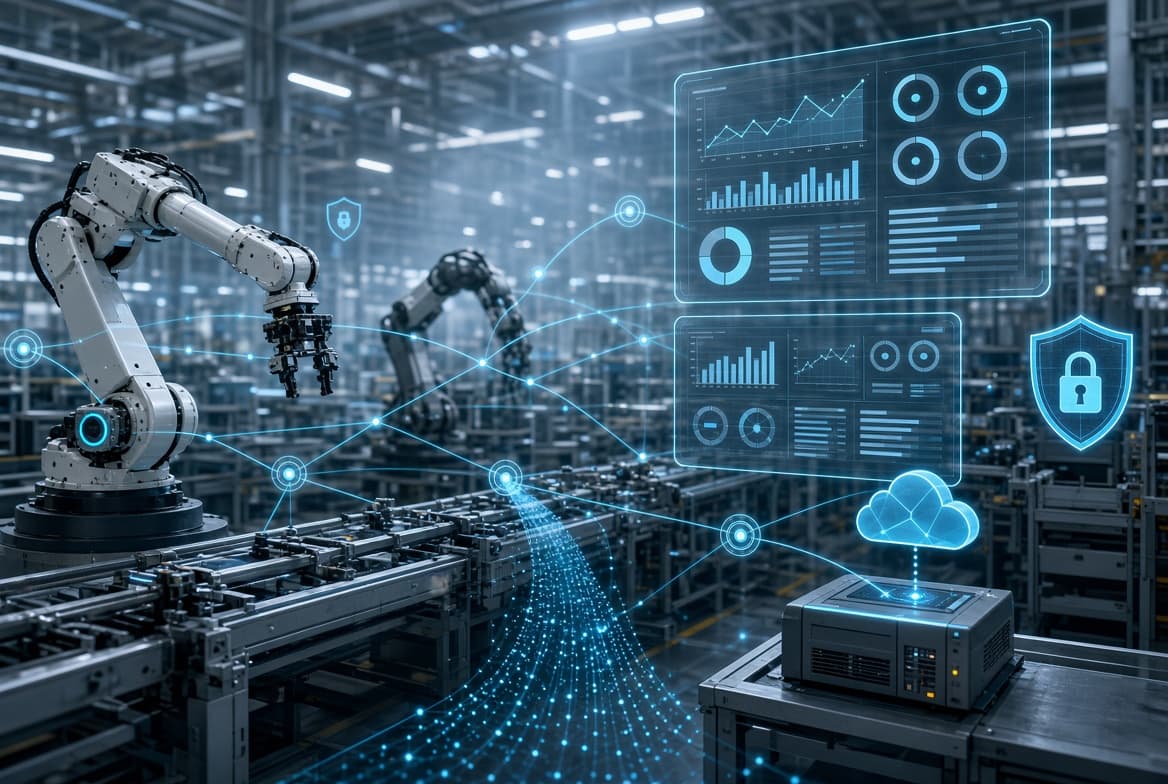
IT solutions for manufacturing connect the systems that run the business with the systems that run production. That can include ERP for finance, procurement, and planning; MES for manufacturing operations; industrial IoT and edge computing for equipment data; and cybersecurity controls designed for IT and operational technology (OT).
The challenge is that a factory cannot always adopt technology the same way an office can. Production systems may need to run continuously, legacy equipment can remain in service for years, and changes to networks or software can affect physical operations.
This guide explains the main IT solutions used in manufacturing, how ERP and MES fit together, when cloud or edge computing makes sense, what predictive maintenance can realistically deliver, what drives implementation costs, and how to evaluate vendors without buying technology before understanding the plant’s actual needs.
IT Solutions for Manufacturing at a Glance
The main categories include:
- ERP: Finance, procurement, inventory, orders, and business planning.
- MES: Production execution, scheduling, quality, work orders, and shop-floor tracking.
- IIoT: Sensors and connected equipment that collect production and asset data.
- Edge computing: Processes industrial data close to machines and production equipment.
- Cloud platforms: Support analytics, centralized data, applications, and multi-site visibility.
- OT cybersecurity: Protects industrial networks, PLCs, SCADA systems, machines, and other operational technology.
- Integration platforms: Connect ERP, MES, equipment, databases, and other manufacturing systems.
The right combination depends on the plant’s processes, existing equipment, downtime tolerance, data requirements, and available IT/OT skills.
What Counts as an IT Solution in a Manufacturing Environment
Manufacturing IT is broader than the office network. It typically spans four layers: business systems (ERP, finance, procurement), operations systems (MES, quality management, warehouse management), the industrial network (sensors, PLCs, SCADA, edge gateways), and the security and infrastructure holding all of it together. A typical office IT rollout can often push a patch overnight and roll it back if something breaks. Manufacturing environments require more controlled changes because a network, software, or equipment failure can affect throughput, quality, safety, or production downtime.
That difference is why manufacturing IT projects often require more planning than a typical office software rollout. A change to a production network, control system, or connected machine can affect throughput, quality, safety, or downtime, so upgrades usually need testing and controlled deployment rather than a simple overnight update.
ERP and MES: Two Systems That Do Different Jobs
Confusing ERP and MES is one of the most common, and costly, mistakes manufacturers make when planning a technology budget. They are not competing products, they operate at different levels of the business, a relationship formalized by ISA-95 (published internationally as IEC 62264), the manufacturing industry’s standard for how enterprise and control systems should exchange information.
| ISA-95 Level | Typical System | What It Handles | Typical Time Horizon |
|---|---|---|---|
| Level 4 | ERP and business systems | Finance, procurement, orders, inventory, business planning | Days to years |
| Level 3 | MES / MOM | Production execution, detailed scheduling, quality, material tracking | Shifts to days |
| Levels 0–2 | Industrial control systems | Physical processes, sensors, PLCs, SCADA and other control functions | Sub-seconds to minutes |
ISA-95, also known as IEC 62264, provides a framework for integrating Level 3 manufacturing operations with Level 4 business systems. It is better understood as an integration and functional model than as a rule that dictates which software a manufacturer must buy.
ERP manages business processes such as orders, inventory, procurement, finance, and planning. MES manages manufacturing operations such as production execution, detailed scheduling, work instructions, quality information, and production tracking. If you’re also evaluating whether you need a full ERP platform or a more focused manufacturing planning system, see our guide to ERP vs. MRP. In a connected environment, information can move between the two so production activity is reflected in business systems and business requirements can inform shop-floor execution.
IT and OT: Two Worlds That Used to Stay Separate
Operational technology (OT), including PLCs, sensors, HMIs, and control systems, runs physical production processes, while information technology (IT) supports business applications, data, and enterprise infrastructure. Connecting these environments creates operational benefits but also new security dependencies. Connected sensors, gateways, remote-access tools, and industrial systems can expand the attack surface when they are poorly segmented or exposed through insecure connections.
Cybersecurity guidance for manufacturers consistently flags this convergence point as one of the highest-risk areas to monitor, which is why security now sits inside the IT solutions conversation rather than off to the side as a separate line item.
Cloud, On-Premise, or Hybrid
There isn’t a universal right answer here, and any article that claims otherwise is selling something. On-premise infrastructure gives manufacturers direct control over latency-sensitive processes and keeps proprietary process data inside the building — a real concern for companies whose competitive edge is a formulation or a machining sequence, not just a brand. Cloud infrastructure gives scalability, easier multi-site visibility, and lower upfront capital cost, but it depends on connectivity and puts data in a third party’s hands.
A hybrid model can be practical for manufacturers that need local control over time-sensitive workloads while using cloud services for planning, analytics, or cross-site visibility. The decision usually comes down to how much downtime a plant can tolerate if its internet connection drops, and how many sites need to see the same data at once.
Edge Computing and the Real-Time Data Problem
Edge computing processes data close to where it is generated rather than sending every workload to a distant cloud environment. This can be useful when a manufacturing application needs low and predictable latency, continued operation during connectivity interruptions, local data processing, or direct access to industrial equipment.
The exact requirement depends on the workload. A closed-loop machine-control application may require extremely low and deterministic latency, while a quality-inspection pipeline, equipment-monitoring application, or production dashboard may tolerate more delay. The point is not that cloud computing is too slow; it is that workload placement should match the operational requirement.
| Factor | Edge Computing | Cloud Computing |
|---|---|---|
| Processing location | Close to machines or production equipment | Remote cloud infrastructure |
| Latency | Can provide low and more predictable local response | Depends on network path, architecture, and cloud region |
| Connectivity | Can continue selected workloads during connectivity interruptions | Usually depends more heavily on network connectivity |
| Data handling | Filters, processes, or analyzes data locally before transmission | Well suited to centralized storage, analytics, and cross-site aggregation |
| Best fit | Time-sensitive processing, local analytics, equipment connectivity | Enterprise analytics, long-term storage, multi-site visibility, centralized applications |
Neither approach replaces the other. The pattern that has held up in practice is placing each workload where it makes sense — control loops at the edge, strategic analytics in the cloud — rather than forcing an entire plant onto one model.
Industrial IoT and Predictive Maintenance
Industrial IoT (IIoT) platforms collect data from sensors attached to motors, pumps, and production lines, then feed that data into analytics tools that flag problems before they cause a breakdown. This is the basis of predictive maintenance, which replaces both “run it until it breaks” and rigid calendar-based servicing with maintenance triggered by actual equipment condition.
McKinsey research has reported potential maintenance-cost reductions of roughly 18 to 25 percent from digitally enabled maintenance and has also cited 30 to 50 percent reductions in machine downtime from predictive-maintenance approaches. These figures are not guaranteed benchmarks for every factory: results depend on the equipment involved, sensor coverage, data quality, maintenance processes, and how quickly teams act on the predictions.
That distinction matters. Predictive maintenance is not simply a matter of installing sensors and waiting for savings. The plant needs reliable data, appropriate models, maintenance workflows, and people who trust and act on the alerts.
Cybersecurity: Why Manufacturers Became the Top Target
Manufacturing remains one of the most heavily targeted industries for cyberattacks. IBM’s 2026 X-Force Threat Intelligence Index reported that manufacturing accounted for 27.7% of the cybersecurity incidents it tracked in 2025, making it the most targeted industry in the report for the fifth consecutive year.
The risk is not limited to corporate IT. Manufacturing environments also contain operational technology such as PLCs, industrial control systems, HMIs, and other equipment that can be difficult to patch or replace without affecting production. An incident that begins in an IT environment can therefore create operational consequences when systems are connected.
The 2025 cyberattack on Asahi Group Holdings illustrates how an incident affecting corporate systems can disrupt manufacturing and distribution. Asahi confirmed that a ransomware attack detected on September 29 disrupted system-based order processing and shipments across its Japanese operations. The company began partial manual order processing and shipments while it worked to restore affected systems. Qilin later claimed responsibility for the attack, although Asahi did not initially identify the attacker.
The financial impact was also significant. Reuters reported that sales in Asahi’s main domestic beverage and food businesses fell by 10% to 40% year over year in October 2025, although that figure represents sales performance during the disruption rather than a simple one-to-one measure of the cyberattack’s financial cost.
The useful lesson for manufacturers is not the exact percentage. It is that ransomware affecting enterprise systems can interrupt ordering, shipping, customer service, and production-related operations at the same time.
Two standards frameworks address this directly:
- NIST Cybersecurity Framework Manufacturing Profile: NIST’s Manufacturing Profile provides a voluntary, risk-based approach for reducing cybersecurity risk in manufacturing environments. The current final profile is IR 8183 Rev. 1; NIST released IR 8183 Rev. 2 as an initial public draft aligned with CSF 2.0 in September 2025.
- ISA/IEC 62443: This series defines cybersecurity requirements and processes for industrial automation and control systems. It addresses security across the lifecycle and includes requirements for asset owners, service providers, system integrators, product suppliers, and individual components.
Neither framework automatically creates a legal compliance obligation for every manufacturer. Their practical value is as a way to structure risk management, define security requirements, assess industrial environments, and communicate security expectations with customers, suppliers, and other stakeholders. Specific contractual or regulatory requirements depend on the manufacturer, industry, geography, and customer relationships.
The Question Vendors Rarely Answer Directly: What Does This Actually Cost?
There is no reliable single price for manufacturing IT. The total cost depends on the number of plants, users and machines, existing infrastructure, software licensing, integration requirements, data migration, implementation services, training, cybersecurity controls, and ongoing support.
The software subscription or license is only one part of the budget. Integration with existing ERP, MES, equipment, databases, and identity systems can add significant implementation work, while legacy data cleanup, network upgrades, plant-floor hardware, testing, and employee training can create additional costs.
Before comparing vendor quotes, separate the budget into at least five categories:
| Cost Area | What to Include |
|---|---|
| Software | Licenses, subscriptions, modules, user or device fees |
| Implementation | Configuration, customization, integration, testing |
| Infrastructure | Servers, gateways, networking, sensors, edge hardware |
| Migration and training | Data cleanup, migration, documentation, training |
| Ongoing operations | Support, upgrades, security monitoring, administration |
The useful comparison is therefore not simply “Which platform costs less?” It is “What will this system cost to implement and operate over the period we expect to use it?”
Common Manufacturing IT Vendors by Category
This is not a ranking. The appropriate vendor depends on plant type, company size, existing systems, industry requirements, geography, and implementation capability. The examples below are useful starting points for a shortlist rather than recommendations.
| Category | Example Vendors / Platforms | Typical Considerations |
|---|---|---|
| ERP | SAP, Oracle, Microsoft Dynamics 365, Infor, Epicor | Plant complexity, finance, supply chain, production planning, multi-site requirements |
| MES / MOM | Siemens Opcenter, Rockwell FactoryTalk, AVEVA, Tulip, MachineMetrics | Production execution, quality, scheduling, traceability, industry requirements |
| IIoT / industrial platforms | Microsoft Azure IoT, AWS IoT, PTC ThingWorx, Siemens Insights Hub | Connectivity, data collection, analytics, edge integration |
| OT security | Claroty, Dragos, Fortinet, Rockwell Automation | Asset visibility, network monitoring, segmentation, threat detection |
| Edge platforms | Microsoft Azure IoT Operations, industrial edge platforms, plant-local gateways | Local processing, connectivity, protocol support, offline operation |
For ERP specifically, current Gartner research evaluates a broad field of cloud ERP providers for product-centric enterprises rather than a simple two-vendor market.
Vendor names should therefore be treated as examples to investigate, not evidence that one platform is automatically the market leader or best fit.
How to Compare Manufacturing IT Solutions
Once you have a shortlist, compare vendors against the same requirements rather than judging each product from a separate sales demonstration.
| Evaluation Area | Questions to Ask |
|---|---|
| Manufacturing fit | Does it support your production model, processes, and industry requirements? |
| Integration | Can it connect with your ERP, MES, PLC, SCADA, databases, and other systems? |
| Deployment | Does it support cloud, on-premise, edge, or hybrid requirements? |
| Data | Can you access and use production data without creating another isolated data silo? |
| Security | How are identities, remote access, segmentation, updates, and logging handled? |
| Reliability | What happens if the network or cloud connection becomes unavailable? |
| Scalability | Can the platform support additional lines, plants, users, or machines? |
| Implementation | Who handles configuration, integration, migration, testing, and training? |
| Total cost | What will licensing, implementation, infrastructure, support, and upgrades cost over time? |
| Exit options | Can you export your data and replace components without rebuilding the entire environment? |
A technically impressive platform is not necessarily the best choice. The better option is usually the one that solves the highest-value operational problem without creating unnecessary integration, security, or support complexity.
Common Mistakes When Selecting IT Solutions
A few patterns show up repeatedly in manufacturing IT projects that stall or underdeliver:
- Buying the platform before mapping the process. Software gets selected based on a vendor demo rather than the actual sequence of work on the floor, and the gap surfaces during implementation.
- Treating OT security as an IT afterthought. Segmentation and monitoring get bolted onto the network months after new IIoT devices are already connected.
- Underestimating integration work. ERP and MES rollouts are frequently budgeted as software costs alone, when the harder and more expensive part is usually the data mapping and integration between systems.
- Skipping the pilot. Rolling a new system out plant-wide before testing it on one line removes the chance to catch problems while they’re still cheap to fix.
A Simple Framework for Choosing IT Solutions for Manufacturing
Before shortlisting any vendor, answer these in order:
- What decision does this data support, and who makes it?
- How much latency can that decision tolerate — seconds, minutes, or a full shift?
- Does the data need to leave the building, or does it need to stay local for competitive or contractual reasons?
- What happens to production if this system’s connection fails for an hour?
- What existing system will this replace, integrate with, or sit beside?
- Who will own the system after implementation — IT, operations, engineering, or a shared team?
Manufacturers who work through these before shortlisting vendors tend to end up with infrastructure that matches how the plant actually runs, not infrastructure built around what a salesperson recommended.
What Manufacturing IT Solutions Make Sense at Different Scales?
The right technology stack changes with the size and complexity of the operation.
Small manufacturers: Start with reliable ERP, inventory and production scheduling, basic cybersecurity, and selective equipment connectivity. A full MES or plant-wide IIoT platform may be unnecessary if production can already be tracked effectively with simpler tools.
Mid-sized manufacturers: Integration becomes more important. ERP, MES, quality systems, warehouse operations, machine data, and cybersecurity may need to work together across multiple production areas or sites.
Large manufacturers: Multi-site visibility, standardized processes, advanced MES/MOM capabilities, centralized analytics, OT security, and integration across plants become more important. These organizations also need stronger governance around architecture, data, identity, and vendor management.
The goal is not to build the most sophisticated technology stack. It is to build enough capability to solve the operational problems that matter most.
Where IT Investment Doesn’t Pay Off Right Away
It’s worth being honest about the limits here. A small job shop running a handful of general-purpose machines often gets little from a full MES deployment, the overhead of configuring and maintaining it can exceed the value it returns. Predictive maintenance analytics need months of clean sensor data before the models are reliable, so it’s not a fix for an immediate downtime crisis. And any manufacturer without the internal capacity to manage OT segmentation and monitoring should treat new IIoT connectivity as added risk until that capacity exists, not as a free efficiency win.
Looking Ahead
Manufacturing technology is moving toward architectures that connect plant-floor data with enterprise systems without requiring every workload to run in the same environment. For manufacturers replacing aging infrastructure across multiple systems, these projects can also become part of a broader IT modernization strategy.
That means more edge processing for local industrial workloads, cloud services for centralized analytics and multi-site visibility, stronger IT/OT security integration, and more modular applications that can be introduced without replacing an entire technology stack.
The practical trend matters more than the label. Manufacturers are increasingly choosing where each workload should run based on latency, reliability, security, data requirements, and business value rather than treating “cloud” or “on-premise” as a complete strategy.
FAQs
What is the difference between ERP and MES in manufacturing?
ERP runs the business — finance, orders, planning. MES runs the shop floor, work orders, scheduling, real-time tracking. Under ISA-95, ERP is Level 4 and MES is Level 3; they’re meant to work together, not replace each other.
Do small manufacturers need a full MES system?
Not usually. It pays off once order volume, product variety, or compliance needs outgrow manual tracking — smaller shops often do fine with simpler scheduling tools.
Why is manufacturing such a common target for cyberattacks?
Downtime is expensive and OT systems are hard to patch, which has made manufacturing the most-attacked sector for five years running, per IBM X-Force.
Should a manufacturer choose cloud or on-premise infrastructure?
Most run hybrid — control and safety systems stay local, planning and analytics move to the cloud — based on tolerable downtime and multi-site needs.
What is edge computing and why does it matter for factories?
It processes data on-site instead of in a distant data center, cutting response time for things like machine control and quality inspection.
How much can predictive maintenance actually save?
McKinsey research has reported roughly 18–25% potential maintenance-cost reductions and 30–50% reductions in machine downtime in different digitally enabled maintenance studies. Actual results vary by equipment, data quality, maintenance processes, and implementation.
What is IEC 62443, and does a manufacturer have to comply with it?
It’s the international OT security standard. It’s not legally required for most manufacturers, but insurers and large customers increasingly expect alignment with it.
What’s the biggest mistake manufacturers make when adopting new IT systems?
Picking software off a vendor demo before mapping the actual shop-floor process — the mismatch surfaces expensively during implementation.
What are the main types of IT solutions used in manufacturing?
The main categories are ERP, MES/MOM, industrial IoT, edge computing, cloud platforms, OT cybersecurity, data and analytics platforms, and systems integration. Manufacturers usually combine several rather than relying on one platform.
References
- International Society of Automation (ISA). ISA-95 Series of Standards: Enterprise-Control System Integration.
- International Society of Automation (ISA). ISA/IEC 62443 Series of Standards.
- National Institute of Standards and Technology (NIST). Cybersecurity Framework Manufacturing Profile, IR 8183 Rev. 1.
- National Institute of Standards and Technology (NIST). Cybersecurity Framework 2.0 Manufacturing Profile, IR 8183 Rev. 2 — Initial Public Draft.
- IBM. X-Force Threat Intelligence Index 2026: Manufacturing cyberattack trends.
- McKinsey & Company. Digitally enabled reliability: Beyond predictive maintenance.
- McKinsey & Company. Manufacturing: Analytics unleashes productivity and profitability.
- Gartner. Magic Quadrant for Cloud ERP for Product-Centric Enterprises, 2025.
- Asahi Group Holdings. Updates on system disruption due to cyberattack, 2025.