
What Is IT Asset Management? A Practical Guide to ITAM
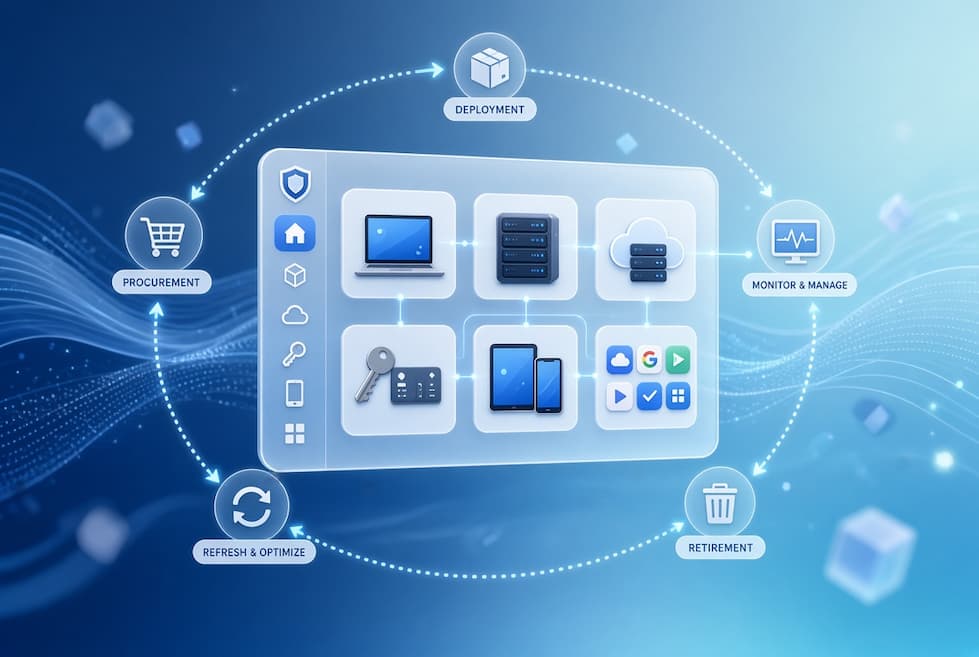
IT asset management, usually shortened to ITAM, is the practice of tracking and controlling the hardware, software, cloud resources, SaaS subscriptions, and digital services an organization owns or pays for. ITAM covers the full lifecycle of these assets, from procurement and deployment to maintenance, renewal, reassignment, and retirement.
The goal is not simply to know what exists. A useful ITAM program helps an organization understand who is using each asset, what it costs, whether it is properly licensed or secured, and when it needs attention.
ITAM often appears in everyday tasks: a help desk asking for an asset tag, a software renewal arriving before the budget is approved, or a laptop being wiped and reassigned after an employee leaves. Without reliable asset records, these small gaps can become larger problems, including unexplained subscription costs, failed audits, unmanaged devices, and data left on retired equipment.
What IT Asset Management Actually Covers
The scope is broader than “hardware and software.” The ISO/IEC 19770 standards family treats IT asset management as a broader discipline covering asset information, lifecycle processes, software identification, usage rights, and related management practices. In practice, that can include laptops, servers, network equipment, software licenses, SaaS subscriptions, cloud resources, mobile devices, and other technology services.
ITAM is usually described as three things working together: a system (the source of truth for asset data), a process (how assets move through their lifecycle), and technology (discovery tools, license management, reporting). Miss one of the three and the other two drift out of sync with reality quickly. ITAM also works closely with IT infrastructure management, which focuses on operating, maintaining, monitoring, and securing the technology environment in which those assets run.
The IT Asset Lifecycle
Every asset, whether it’s a laptop or a software license, moves through a similar arc:
- Plan and request — someone identifies a need and it gets approved.
- Procure — the asset is purchased or licensed, ideally against a defined specification.
- Deploy — hardware gets configured and handed off; software gets installed and assigned.
- Manage and maintain — the asset is monitored, patched, reassigned, or renewed over its working life.
- Retire — the asset is decommissioned, data is wiped, and hardware is disposed of or resold, or a license is reclaimed and reallocated.
The exact steps vary by asset type. A laptop may require imaging, warranty tracking, repair, and secure disposal, while a SaaS subscription may require approval, user assignment, renewal review, usage analysis, and cancellation.
Retirement gets skipped more often than it should. A laptop that is never formally decommissioned may remain in inventory, consume a management license, and retain data that was never securely wiped. A software license nobody reclaims after an employee leaves is just money sitting idle. Accurate asset records also support IT modernization by helping teams identify unsupported systems, aging hardware, duplicated tools, and workloads that may need to be replaced or redesigned.
SAM, HAM, and the Newer Layer: SaaS and Cloud
ITAM brings together several related practices, including Hardware Asset Management, Software Asset Management, and the tracking of SaaS and cloud resources.
- Hardware Asset Management (HAM) manages physical devices such as computers, servers, network equipment, and mobile devices through procurement, deployment, servicing, and retirement.
- Software Asset Management (SAM) manages licenses, installations, usage rights, and vendor terms, with a strong focus on compliance and cost control.
- SaaS and cloud asset management tracks subscriptions, cloud resources, usage, ownership, and spending across services that may be purchased or provisioned outside traditional IT processes.
SaaS sprawl makes ITAM harder because departments can start subscriptions without following the same approval or inventory process. As organizations adopt more SaaS, cloud, and AI tools, they need clearer ownership, renewal tracking, usage analysis, and spending visibility.
| Discipline | Focus | Typical Owner | Main Risk If Neglected |
|---|---|---|---|
| Hardware Asset Management (HAM) | Physical devices, lifecycle from procurement to disposal | IT operations | Lost/stolen equipment, unsecured retired devices |
| Software Asset Management (SAM) | Licenses, installs, usage rights | IT/procurement | Audit penalties, over- or under-licensing |
| SaaS/Cloud Asset Management | Subscriptions, cloud instances, usage-based spend | IT, increasingly shared with finance/FinOps | Shadow IT, duplicate tools, wasted spend |
| IT Asset Management (ITAM) | All of the above, end to end | IT asset manager or ITAM team | Fragmented data, no single source of truth |
ITAM vs. CMDB: A Common Point of Confusion
These two terms get used almost interchangeably, but they answer different questions. ITAM tells you what you own, what it costs, and who’s responsible for it. A Configuration Management Database (CMDB), commonly used to support IT service management and configuration management, records configuration items and the relationships between them. It helps teams understand what a server connects to, which services depend on it, and what might be affected if it fails.
An item can be tracked in both systems for different reasons: a server needs an asset record for cost and warranty, and a configuration item (CI) record showing what would be affected if it failed. Neither system replaces the other.
| Area | IT Asset Management | CMDB |
|---|---|---|
| Core question | What do we own, use, pay for, and manage? | How are systems and components related? |
| Primary data | Ownership, cost, warranty, contracts, licenses, lifecycle status | Configuration items, dependencies, relationships, and technical attributes |
| Main purpose | Budgeting, renewals, lifecycle planning, audits, and optimization | Change impact analysis, incident response, and service management |
| Typical data sources | Procurement, finance, discovery tools, contracts, license records | Discovery tools, service maps, monitoring systems, and ITSM workflows |
| Can they overlap? | Yes | Yes |
| Do they replace each other? | No | No |
The Standards Behind ITAM
ISO/IEC 19770 provides a standards framework for IT asset management. Different parts address the management system, software identification, entitlement and usage rights, resource utilization reporting, and shared terminology. The standards can help organizations structure and mature their ITAM practices, but they should not be presented as a simple checklist or universal pass/fail certification.
Security frameworks lean on ITAM too. NIST’s Cybersecurity Framework includes asset management as an important part of understanding an organization’s hardware, software, systems, data, and related technology environment. Accurate asset information supports better risk assessment, vulnerability management, and incident response.
Why It Matters: Cost, Compliance, and Security
ITAM matters because organizations cannot manage technology costs, licensing obligations, security exposure, or refresh planning without reliable asset information.
A mature ITAM program helps answer practical questions:
- Which devices and applications does the organization own?
- Who is responsible for each asset?
- Which software licenses are assigned, unused, or approaching renewal?
- Which cloud and SaaS services are creating unexpected costs?
- Which devices or applications are unsupported or missing security controls?
- What equipment or data must be retired, transferred, or securely disposed of?
For example, an organization may discover that it is paying for 200 software seats but only 130 are actively used. ITAM can help identify the unused licenses, confirm whether they can be reassigned, and provide better information before the next renewal. The same records may also reveal devices that are unsupported, unencrypted, or assigned to former employees.
Common IT Asset Management Tools
ITAM tools generally fall into three categories:
- Dedicated ITAM and SAM platforms: Designed for hardware lifecycle tracking, software licensing, entitlement management, and audit preparation.
- ITSM platforms with asset modules: Combine asset records with help desk, incident, request, and change-management workflows.
- SaaS management platforms: Focus on application discovery, subscription ownership, user activity, renewal tracking, and SaaS spending.
Examples include Flexera and Snow Software for ITAM/SAM, ServiceNow and Ivanti for ITSM-connected asset management, and Zylo or similar platforms for SaaS management. Product capabilities and pricing vary, so organizations should compare integrations, discovery methods, reporting, licensing support, and total cost before choosing.
Common Challenges in Practice
A few problems show up in nearly every ITAM program that hasn’t matured yet:
- Spreadsheet dependence: Fine for a small number of devices, but difficult to scale when records need reconciliation, audit trails, renewal alerts, and ownership updates.
- AI and SaaS tool sprawl: Teams can adopt SaaS products, cloud services, and AI tools faster than governance processes can track them. Without ownership, approval, usage, and budget information, organizations may pay for duplicate services or expose data through unmanaged tools.
- Fragmented ownership: Hardware may sit with IT operations, software with procurement or SAM specialists, and cloud spending with FinOps. Without coordination, each group works from only part of the overall picture.
Who Should Actually Own IT Asset Management: IT or Finance?
ITAM usually works best as a shared operating discipline. IT often manages discovery and lifecycle processes, while finance, procurement, security, HR, and business teams contribute information and make decisions within their areas of responsibility.
- IT or a dedicated ITAM/SAM team: Owns discovery, reconciliation, and day-to-day lifecycle tracking. This information usually needs to be maintained by the team with access to the relevant systems.
- Finance or FinOps: Supports spending decisions, especially for cloud and SaaS services where costs are usage-based rather than fixed.
- Security: Uses ITAM data for vulnerability management, incident response, access reviews, and risk assessment, even when security does not operate the inventory process directly.
A practical model is: IT maintains the operational records, finance and procurement support cost and contract decisions, security uses the data for risk management, and business owners remain accountable for appropriate use.
Choosing an Approach: A Decision Framework
Match the investment to the situation, not the other way around:
The device count is only a rough illustration. Complexity, regulatory requirements, SaaS usage, and the cost of poor records matter more than a fixed number of devices.
| Situation | Reasonable Approach |
|---|---|
| Fewer than approximately 25 devices, no SaaS sprawl, no regulatory exposure | A well-maintained spreadsheet or lightweight tracker may be enough, with a plan to graduate later |
| Growing headcount, multiple offices or remote staff, several SaaS tools per department | Dedicated ITAM or SaaS management software, likely bundled with an ITSM/help desk platform |
| Regulated industry, frequent audits, complex license agreements | Purpose-built SAM/ITAM platform with license optimization, audit defense, and reporting features |
| Heavy cloud and AI spend, cross-team ownership | ITAM platform with FinOps integration, since cloud cost optimization is increasingly shared between the two functions |
Organizations may combine more than one tool category. For example, a company might use an ITSM platform for asset records, a SAM platform for software licensing, and a SaaS management platform for subscription visibility. Integrations are important because disconnected systems can recreate the same data problems ITAM is meant to solve.
Common Misconceptions
“ITAM is just an inventory list.” Inventory is the starting point, not the goal — the value is in what you do with the data: reclaiming licenses, catching security gaps, planning refresh cycles.
“ITAM and a CMDB are the same thing.” One tracks ownership and cost, the other tracks relationships and dependencies. Mature organizations run both and connect them.
“Moving to the cloud means less to manage.” Cloud and SaaS adoption can increase the number of things to track, especially when departments can provision services without following the same IT approval or inventory process.
“Small businesses don’t need this.” The scale should match the organization, but even a ten-person company benefits from knowing which software it’s licensed to use and which devices hold company data.
Best Practices Worth Prioritizing
Effective ITAM depends more on reliable processes and ownership than on buying the most expensive platform. Start with a defined asset scope, consistent data, and clear accountability.
- Use more than one discovery method. Agent-based discovery, agentless discovery, network scanning, procurement records, and expense data may reveal different assets.
- Assign a named owner to every asset category, not just a department.
- Connect provisioning with HR onboarding and offboarding so departures can trigger device recovery and license reclamation.
- Reconcile ITAM data against procurement and financial records regularly.
- Record lifecycle status, ownership, location, warranty, contract, and renewal information consistently.
- Standardize naming conventions before building complex reports. For example, using “laptop” in one department and “notebook-PC” in another can weaken reconciliation and create duplicate records.
- Review and document who can create, modify, or retire asset records.
- Review unused SaaS licenses and cloud resources before renewals.
- Define a secure retirement process for devices, accounts, software, and data.
Where ITAM Is Heading
ITAM is expanding beyond traditional hardware and software records. SaaS subscriptions, cloud resources, AI services, developer tools, and usage-based platforms are creating new asset categories that may not follow traditional procurement processes.
Three developments are especially important:
- AI and SaaS visibility: Organizations need to identify which tools are being used, who approved them, what data they access, and whether they deliver enough value.
- Cloud and FinOps collaboration: Cloud costs are often usage-based, so ITAM data increasingly needs to connect with finance, procurement, and FinOps processes.
- More automated discovery: Discovery, identity, expense, endpoint, and cloud-management data can be combined to identify assets that traditional inventories miss.
The result is a broader ITAM role. Instead of tracking only equipment and licenses, ITAM increasingly supports cost control, security, governance, procurement, and technology planning.
Final Thoughts
Organizations with effective ITAM do not necessarily have the most expensive tools. They have reliable asset records, clear ownership, repeatable lifecycle processes, and a habit of reviewing the data before a renewal, audit, security incident, or hardware failure forces the issue.
The platform matters, but the discipline matters more. ITAM creates value when the information is accurate enough to support real decisions about cost, risk, compliance, security, and technology investment.
FAQs
What is IT asset management in simple terms?
Tracking every piece of technology a company owns or pays for, from purchase to retirement, so you always know what exists, who’s using it, and what it costs.
What’s the difference between ITAM and a CMDB?
ITAM tracks ownership and cost; a CMDB tracks how systems relate to and depend on each other. Most mature organizations run both.
What’s the difference between SAM and HAM?
SAM manages software licenses and compliance; HAM manages physical devices through their lifecycle. Both are subsets of ITAM.
Do small businesses need dedicated ITAM software?
Not immediately, a well-kept spreadsheet works until headcount, SaaS tools, or audit requirements outgrow it.
How does ITAM help with cybersecurity?
ITAM helps security teams identify devices, applications, cloud resources, and owners so they can prioritize patching, vulnerability management, access reviews, and incident response.
What causes shadow IT, and how does ITAM address it?
Shadow IT occurs when employees or departments adopt technology without following the organization’s approval process. ITAM can help identify it through procurement records, expense data, identity systems, endpoint discovery, cloud billing, and SaaS-management tools.
Why do software audits happen, and how does ITAM reduce the risk?
Vendors check whether software usage matches the organization’s license agreements. Accurate and reconciled ITAM/SAM records help identify gaps early, support audit preparation, and provide evidence during discussions with the vendor.
Is AI software part of IT asset management now?
Yes. AI applications, APIs, subscriptions, and cloud services can be tracked as IT assets when the organization owns, pays for, or uses them.
What does ITAM software do?
ITAM software helps organizations discover assets, maintain ownership and lifecycle records, track licenses and contracts, monitor renewals, identify unused resources, and produce reports for cost, compliance, and security decisions. Some platforms also connect with ITSM, HR, procurement, endpoint management, and cloud systems.
What is the difference between ITAM and SAM?
ITAM covers the broader technology asset lifecycle, while SAM focuses specifically on software licenses, installations, usage rights, and vendor compliance.
References
- ISO/IEC — IT asset management standards and ISO/IEC 19770 overview
- NIST — Cybersecurity Framework
- NIST NCCoE — IT Asset Management practice guidance
- Flexera — State of ITAM report
- FinOps Foundation — FinOps Framework
- PeopleCert — ITIL configuration management guidance