

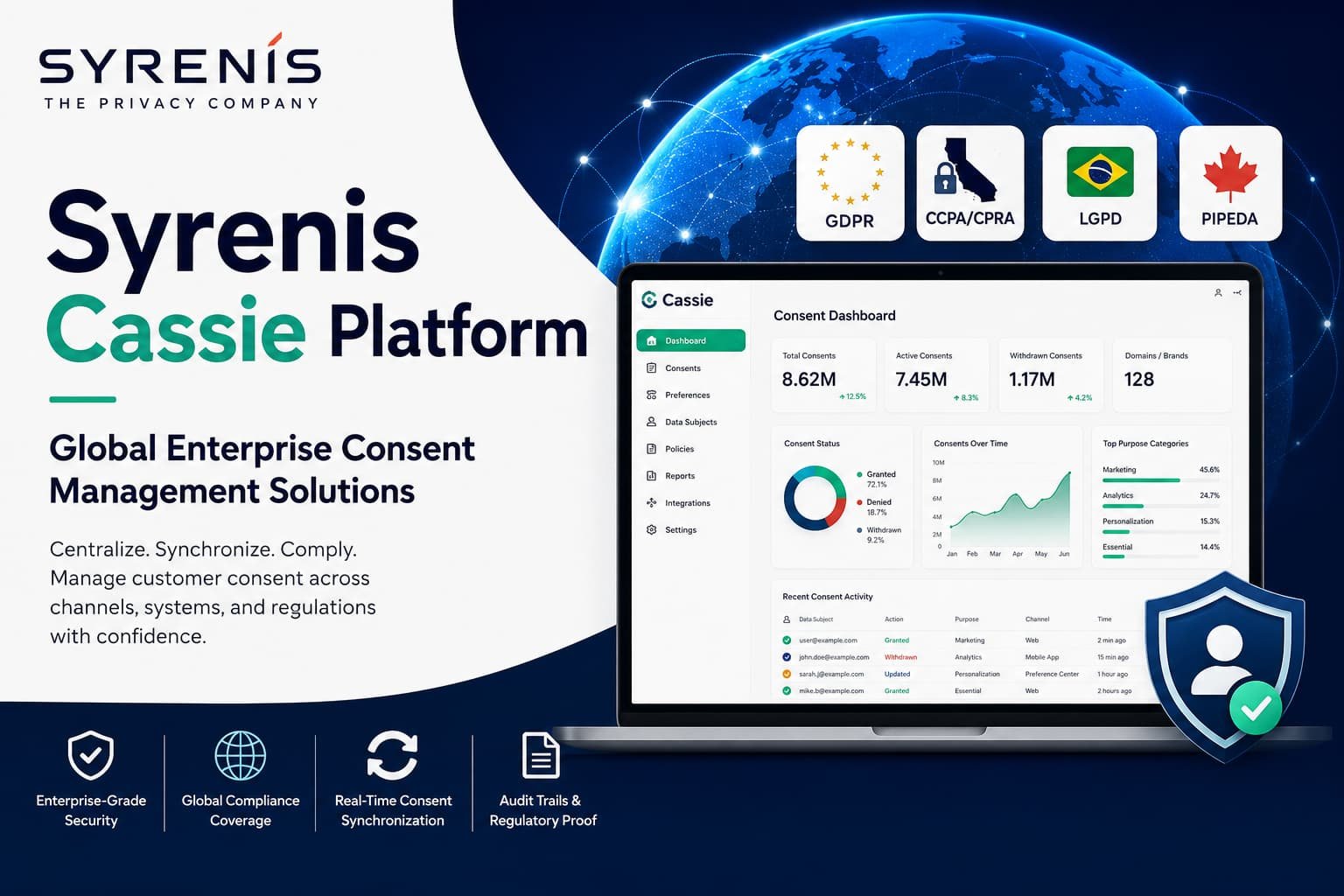
Syrenis Cassie Platform: Global Enterprise Consent Management Solutions
The Syrenis Cassie platform is an enterprise consent and preference management platform designed for organizations that need to collect, manage, and enforce customer consent across multiple systems, brands, countries, and regulatory frameworks.
Unlike basic cookie consent tools, Cassie acts as a centralized consent repository. It synchronizes consent decisions across websites, mobile apps, CRM platforms, marketing automation tools, customer data platforms (CDPs), and internal business systems. This helps enterprises maintain consistent consent records while supporting privacy regulations such as GDPR, CCPA/CPRA, LGPD, and other regional requirements.
The Syrenis Cassie Platform is built specifically for enterprise consent management, enabling organizations to centralize customer preferences, synchroniz consent records, and comply with global privacy regulations across complex technology ecosystems.
This guide explains how the platform works, where it fits within an enterprise privacy architecture, its strengths, limitations, and how it compares with other enterprise consent management solutions.
Why Enterprise Consent Management Matters
Enterprise consent management becomes difficult when customer data flows across multiple websites, mobile apps, CRM systems, analytics platforms, and marketing tools. Capturing consent is only part of the process, the greater challenge is ensuring every connected system respects that decision consistently.
Privacy regulations such as GDPR, CCPA/CPRA, LGPD, and other regional laws require organizations to demonstrate not only that consent was collected, but that it can be updated, withdrawn, and enforced throughout the data lifecycle. Enterprise consent platforms are designed to solve this operational challenge by keeping consent records synchronized across business systems.
Enterprise Consent Management Capabilities
Rather than functioning as a standalone cookie banner, Cassie acts as a centralized consent service that integrates with enterprise technology stacks.
Instead of focusing only on cookie consent, Cassie provides several enterprise capabilities designed for large organizations:
- Consent capture through configurable preference centers and cookie banners
- Cross-domain consent synchronization across multiple websites and brands
- Identity-based consent linked to authenticated customer profiles
- Multi-device preference synchronization through Follow-Me Consent
- REST APIs and webhooks for real-time enforcement
- Immutable audit trails for regulatory evidence
Unlike many consent tools that stop at collecting user preferences, enterprise platforms are expected to enforce those decisions consistently across downstream systems That distinction is one of the main reasons organizations adopt platforms like Cassie instead of standalone cookie banner solutions.
One detail many product summaries overlook is that these capabilities only become valuable when they’re connected to downstream systems. Capturing consent is relatively straightforward; ensuring that every connected application respects updated permissions is the more difficult enterprise challenge.
What Does Syrenis Cassie Cost?
Syrenis does not publicly disclose standard pricing for the Cassie platform. Pricing is typically customized based on factors such as deployment requirements, the number of brands or environments, integrations, and the volume of consent transactions being managed.
Organizations interested in Cassie generally need to request a custom quote directly from Syrenis. Because enterprise consent management requirements vary significantly across industries and regulatory environments, customized pricing is common among enterprise privacy and consent platforms.
Is Syrenis Cassie Worth It?
Cassie is worth considering for organizations that manage consent across multiple brands, countries, and business systems. Its strengths lie in consent orchestration and enterprise integrations rather than broad privacy governance.
For smaller businesses or companies that only need cookie consent banners Cassie will likely be more powerful and expensive than necessary.
Organizations should evaluate whether they need dedicated consent management or a broader privacy compliance platform before investing in enterprise software.
Has the Syrenis Cassie Platform Faced Regulatory Scrutiny?
At the time of writing, the Syrenis Cassie Platform has not faced any major public regulatory scrutiny or enforcement actions. The platform is designed to help organizations comply with privacy regulations rather than replace their legal compliance responsibilities.
Like all consent management platforms, compliance ultimately depends on how organizations configure and implement their consent policies and workflows.
Global Compliance and Regulatory Support
Large organizations often operate in many jurisdictions, each with its own privacy rules. Cassie is designed to handle this complexity. For example, Syrenis highlights multi-jurisdiction policy support and context-aware guidance built into the platform. Cassie’s knowledge base covers major frameworks (GDPR, CCPA, Brazil’s LGPD, Canada’s PIPEDA, etc.) and is continuously updated as laws change. This helps ensure that the correct consent defaults and notices are presented to users in different regions, and that internal teams know how to interpret local regulations.
The platform also enforces regulatory demands like right-to-be-forgotten (data deletion) or access requests through integrated workflows. While Cassie focuses on preferences, it is often used alongside data rights modules. UK guidance, for instance, explicitly states companies must keep “clear records of consent” to show compliance. Cassie’s immutable logs and version-controlled policies mean an organization can produce evidence of who consented to what and when.
In regulated industries (finance, healthcare, etc.), Cassie provides extra assurance. It can be configured to meet industry rules like HIPAA in healthcare, ensuring patient consents for data sharing comply with health privacy laws. And its security posture is enterprise-level: Syrenis maintains SOC 2 Type 2 certification and participates in industry standards programs (IAB CMP compliance, IAPP membership). This underscores that Cassie is not a consumer-grade app, but a hardened system for large-scale use.
Here is a comparison of what a dedicated consent platform like Cassie offers versus a full privacy compliance suite:
| Feature | Cassie (Consent Platform) | Full Compliance Suite (e.g. OneTrust) |
|---|---|---|
| Record of Processing (GDPR Art.30) | Not provided – Cassie focuses on consent, not full data inventory | Provided – Suites include ROPA tools for Article 30 |
| DPIA (GDPR Art.35) | Not provided – Cassie does not handle DPIAs | Provided – Suites include DPIA project support |
| Rights Requests (DSARs) | Preferences only – manages opt-out and opt-in, not full DSAR workflows | Full lifecycle – handles access, deletion, portability per Art. 12-22 |
| Typical Users | Marketing & UX teams managing consent and preferences | Privacy/legal teams managing full compliance program |
| Pricing Model | Volume-based (per environment/brand) | Enterprise license (modules added) |
Table: Consent-focused platforms vs full compliance suites (adapted from industry analysis).
Architecture, APIs, and Enterprise Integrations
Cassie is delivered as a cloud-based SaaS platform designed for enterprise deployments. While Syrenis does not publicly document every architectural component, the platform emphasizes scalability, security, and integration for organizations managing consent across multiple business systems. Data is encrypted in transit and at rest, and Syrenis maintains certifications including SOC 2 Type II and Cyber Essentials Plus.
Enterprise consent platforms are only as effective as their integrations, and this is one of Cassie’s primary areas of focus. Cassie provides a rich API library and pre-built connectors so that consent data can flow bi-directionally with other systems. Marketing automations, CRM systems, customer data platforms (CDPs), email tools, even data warehouses can all consume Cassie’s consent APIs. For instance, in pharma or healthcare, Cassie can integrate directly with EHR/CRM systems to automatically synchronize patient or provider consents. These real-time links mean that whenever a user updates a preference (online or in a call center), all connected systems get the update instantly.
Many enterprise consent platforms also rely on cloud infrastructure for scalability, security, and centralized data management. Organizations unfamiliar with cloud-based enterprise systems can learn more about the benefits of cloud computing and why it plays a critical role in modern business applications.
On the front-end, Cassie offers flexible deployment of consent widgets: whether it’s a web banner (Cookie Management) or a mobile app SDK, the capture mechanisms feed back into the central platform. Cassie can also scan websites and apps to inventory trackers and cookies (via a built-in auditor), giving enterprises a live map of their tracking ecosystem. This helps organizations spot privacy risks (like missing consent for a new tag) and configure policies appropriately.
Use Cases and Industry Examples
Cassie is commonly deployed in industries where customer data is highly regulated or shared across multiple systems. Rather than serving a single website or application, the platform is typically implemented as a centralized consent layer supporting enterprise-wide privacy operations.
- In healthcare and life sciences, patient data and clinical trial information are highly sensitive. Cassie is used to ensure that patient consents (for communications, research participation, data sharing) are captured once and then honored everywhere. For example, an enterprise hospital might use Cassie to sync patient marketing preferences from the website to the patient portal to email systems. The platform’s ability to integrate with EHR and CRM systems is a key factor in this sector.
- In financial services, banks and insurers use Cassie to manage opt-ins for marketing and compliance consents. A bank’s mobile app can hand off consent signals to downstream analytics and partner systems without delay. If a customer withdraws consent, all branches of the bank’s CRM are updated in real time, avoiding risky “shadow processing.”
- Retail and e-commerce companies use Cassie to unify consent across multiple brands and websites. For example, if a customer shops at two brands owned by the same company, Cassie’s cross-domain consent means that opting out on one brand’s site can carry over to the other. This unified approach prevents compliance gaps when marketers sync profiles between sites.
- Technology companies and service providers often integrate Cassie into their suite of data tools. Any large firm with a CDP or data lake can use Cassie’s APIs to enforce user preferences on that data – preventing analytics or ML models from consuming disallowed personal data.
Across these industries, the common requirement is maintaining consistent consent records across multiple systems while meeting regional privacy regulations. That is the operational problem Cassie is designed to address.
Syrenis Cassie vs Other Enterprise Consent Management Platforms
| Platform | Best For | Biggest Strength | Limitation |
|---|---|---|---|
| Syrenis Cassie | Enterprise consent orchestration | Real-time consent synchronization | Not a full privacy suite |
| OneTrust | Enterprise privacy programs | Broad governance features | More complex implementation |
| Didomi | Consent management | European compliance focus | Less enterprise orchestration |
| Usercentrics | Websites and apps | Easy deployment | Narrower enterprise workflow support |
| Osano | SMB compliance | Simplicity | Less suited to global enterprises |
Each solution has its trade-offs. Cassie focuses specifically on enterprise consent and preference management rather than broader privacy governance. Organizations needing capabilities such as automated RoPA management, DPIAs, or DSAR workflows typically deploy it alongside a wider privacy platform instead of replacing one.
Why Cassie Is Different From Traditional CMPs
Many consent management platforms focus primarily on displaying cookie banners.
Syrenis positions the Cassie Platform as an enterprise-grade consent management solution for global enterprises operating across multiple brands, regions, and regulatory frameworks.
Cassie takes a broader approach by treating consent as enterprise data rather than a front-end website feature. Instead of stopping after collecting consent, it distributes consent decisions to connected business systems through APIs and integrations.
For organizations operating across multiple brands, countries, or customer channels, that architectural difference is often more important than the design of the consent banner itself.
Enterprise Implementation Considerations
Before adopting an enterprise consent platform, organizations should evaluate how consent data will integrate with existing business systems. Questions around identity resolution, API availability, legacy applications, regional compliance requirements, and internal governance often determine implementation success more than the consent platform itself.
For many enterprises, deploying the technology is only one part of the project. Defining ownership, maintaining consent policies, and validating integrations are equally important for long-term compliance.
Advantages and Limitations
Advantages
- Centralized enterprise consent repository
- Strong API ecosystem
- Cross-domain and multi-device consent
- Detailed audit records
- Built for large, regulated organizations
Limitations
- Not a complete privacy governance platform
- Requires integration effort
- More capability than many SMBs require
- Enterprise pricing may not suit smaller businesses
Where Cassie May Not Be the Right Choice
Cassie is designed for organizations with complex consent requirements across multiple systems and jurisdictions. Smaller businesses running a single website or basic marketing stack may not benefit from its enterprise capabilities. In many cases, a lightweight consent management platform is easier to implement and maintain.
Organizations should also understand that Cassie focuses on consent and preference management rather than complete privacy governance. Businesses needing automated data mapping, DPIAs, records of processing activities (RoPA), or DSAR workflows typically combine Cassie with broader privacy management platforms instead of relying on it alone.
Why Enterprises Choose Dedicated Consent Platforms
Building consent management internally is possible, but maintaining it over time is considerably more difficult. Privacy regulations evolve, new digital channels are introduced, and enterprise systems continue to grow in complexity. Dedicated platforms like Cassie reduce that operational burden by providing centralized consent records, policy management, audit trails, and integrations that would otherwise require ongoing internal development and governance.
Conclusion
The Syrenis Cassie platform is designed for organizations that view consent as an enterprise-wide operational requirement rather than a website feature. Its strengths lie in centralized consent management, real-time synchronization, and integration with complex business environments.
Organizations evaluating Cassie should also recognize its scope. It excels at consent and preference management but is not intended to replace broader privacy governance platforms. For organizations operating across multiple regions and customer touchpoints, that specialization makes Cassie a practical choice when consent management is the primary requirement rather than full privacy governance.
Frequently Asked Questions
What is the Syrenis Cassie platform?
Cassie is an enterprise consent and preference management platform that centralizes customer consent across websites, apps, CRM systems, and marketing platforms.
Is Cassie only a cookie consent platform?
No. It manages consent across multiple enterprise systems, making it broader than a standard cookie banner solution.
Does Cassie support GDPR?
Yes. It helps organizations capture, store, and enforce consent records required by GDPR and other privacy regulations.
Can Cassie integrate with CRM systems?
Yes. It provides APIs and integrations that synchronize consent with CRM, CDP, marketing automation, and analytics platforms.
Does Cassie replace OneTrust?
Not usually. Cassie specializes in consent management, while OneTrust offers broader privacy governance capabilities.
Which organizations benefit most from Cassie?
Large enterprises operating across multiple brands, countries, or regulated industries typically benefit the most.
References
- Syrenis. Cassie Enterprise Consent Management Platform.
- Syrenis. Cassie Product Overview.
- Syrenis. Consent Management for Healthcare & Life Sciences.
- Syrenis. Enterprise Consent and Preference Management Platform.
- UK Information Commissioner’s Office (ICO). Guide to Consent.
- European Data Protection Board (EDPB). (2020). Guidelines 05/2020 on Consent under Regulation (EU) 2016/679.
- European Parliament and Council of the European Union. (2016). Regulation (EU) 2016/679 (General Data Protection Regulation). Official Journal of the European Union.
- California Legislature. California Consumer Privacy Act (CCPA) and California Privacy Rights Act (CPRA).
- National Institute of Standards and Technology (NIST). (2020). NIST Privacy Framework: A Tool for Improving Privacy through Enterprise Risk Management, Version 1.0.
- International Association of Privacy Professionals (IAPP). Privacy Law and Compliance Resources.
- Entrust. (2025). GDPR vs. CCPA: What’s the Difference?
- Usercentrics. (2024). Preference Management Solutions: Enterprise Consent Management Overview.