
Sales Enablement Platform: How to Choose in 2026
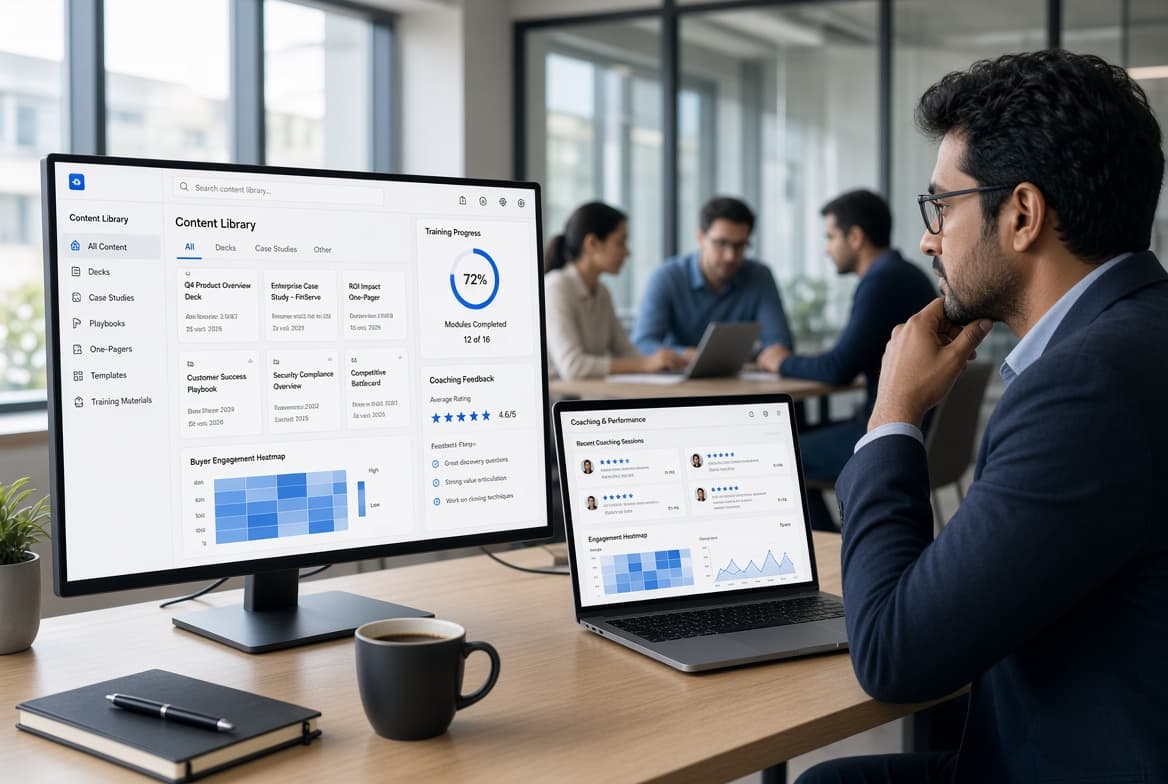
A sales enablement platform helps sales teams find approved content, train representatives, coach performance, and track how buyers engage with sales materials. It typically works alongside a CRM rather than replacing it.
The category is changing quickly. Seismic completed its merger with Highspot in August 2026, Showpad combined with Bigtincan under the Showpad brand, and Salesloft and Clari completed their merger in December 2025. Vendors are also expanding into AI-assisted coaching and revenue workflows.
For buyers, the challenge is not simply choosing software with the most features. It is finding a platform that fits the sales process, integrates with existing systems, supports adoption, and can demonstrate value beyond activity dashboards. This guide explains what these platforms do, how they differ from CRMs and adjacent tools, what to evaluate, and which questions to ask before signing a contract.
Table of Contents
What a sales enablement platform actually does
Four core jobs:
- Content management. One searchable library of decks, one-pagers, case studies and battlecards with version control.
- Learning, practice and coaching. Structured onboarding paths, recorded practice pitches, and manager feedback.
- Guided selling. Content or next-step suggestions triggered by deal stage, buyer role or CRM data.
- Analytics. Trackable links that show who opened what and for how long, ideally linked to deal outcomes.
The term revenue enablement platform is increasingly used for software that supports a broader group of revenue-generating and customer-facing teams, not just sales representatives. Gartner’s November 2025 research used the revenue enablement category and evaluated capabilities including content management, guided selling, learning, coaching, integration and buyer-engagement analytics. However, vendors do not all define the category in exactly the same way. Compare actual capabilities and supported users rather than relying on the product label alone.
How it differs from a CRM and other sales tools
A CRM is the system of record for accounts, contacts and deals. An enablement platform is the system of action for the materials and training around those deals. They connect; they do not replace each other.
| Tool type | Core job | Typical examples | Overlap with enablement |
|---|---|---|---|
| CRM | Accounts, contacts, deals | Salesforce, HubSpot | Light content and playbook features |
| Sales / revenue enablement | Content, training, coaching, buyer tracking | Seismic (incl. Highspot), Showpad, Allego, Mindtickle | — |
| Conversation intelligence | Records and analyzes calls | Gong | Coaching is expanding into formal enablement (Gong Enable) |
| Sales engagement / revenue orchestration | Outreach cadences, communication workflows and revenue-process coordination | Salesloft, Clari | Content sharing, seller guidance and workflow automation |
The lines are blurring because every category is trying to capture the next budget.
Teams that also need call analysis, forecasting or pipeline insights may want to compare revenue intelligence platforms, although those tools solve a different problem from content management and sales training.
What changed in 2026
| Date | Event | Primary source |
|---|---|---|
| April 2025 | Vector Capital completes its acquisition of Bigtincan | Showpad announcement |
| October 2025 | Vector Capital completes its acquisition of Showpad; the combined business operates under the Showpad brand | Showpad announcement |
| November 2025 | Gartner publishes its Magic Quadrant for Revenue Enablement Platforms | Gartner report |
| December 2025 | Salesloft and Clari complete their merger | Salesloft announcement |
| February 2026 | Gong introduces Gong Enable as part of its Mission Andromeda launch | Gong announcement |
| April 2026 | Mindtickle launches ElevateOS | Mindtickle announcement |
| August 2026 | Seismic completes its merger with Highspot | Seismic announcement |
These estimates should not be treated as directly interchangeable. Research firms can use different market definitions, vendor coverage, revenue assumptions and forecasting methods. The figures indicate that analysts expect the category to grow, but they do not establish a single definitive market size.
Use these forecasts as market context rather than proof that every sales enablement platform will grow at the same rate. The forecast period, methodology and definition of the market matter as much as the headline number.
How big is the market, and why do the numbers disagree?
| Research firm | 2025 value | 2026 value | Long-range forecast |
|---|---|---|---|
| Fortune Business Insights | $6.13B | $7.20B | $25.65B by 2034 (17.2% CAGR) |
| Future Market Insights | $6.36B | $7.40B | $33.90B by 2036 |
| Mordor Intelligence | $4.21B | $5.04B | $12.35B by 2031 (19.65% CAGR) |
The spread is definitional. Some firms count only dedicated platforms; others fold in adjacent tools. Treat the numbers as directional. All three agree on double-digit growth and heavy cloud dominance (Fortune ~84 %, FMI 74 % in 2026).
Is a sales enablement platform the same as a CRM?
No. A CRM records who the buyers are and where each deal stands. A sales enablement platform manages what reps send and learn. Most companies run both and integrate them.
What you get, and what you don’t
Where they help
Teams with many representatives, complex product portfolios or frequent hiring may benefit most from structured onboarding and better control over sales content. Buyer-engagement tracking can also give representatives a more specific reason to follow up. Whether those improvements produce measurable ROI depends on adoption, content quality and how the company measures results.
Where they fall short
- Adoption is the real constraint. If the tool is slower than searching email, reps ignore it.
- Content sprawl simply moves inside the platform unless someone owns governance.
- Revenue attribution is usually correlation, not causation. Win-rate dashboards look impressive; few buyers can isolate the platform’s true causal impact.
- “Agentic AI” claims are widespread in 2026. Insist on a live workflow using your own content, not a demo dataset.
How do you prove the platform caused the higher win rate?
Most dashboards show that deals with more content engagement closed more often. That is correlation. A controlled pilot or a rigorous analysis that accounts for factors such as lead quality, territory, pricing, product changes and manager performance can provide stronger evidence of impact. The right method depends on the business and available data. Ask vendors how their attribution model works, what factors it controls for, and whether the results can be independently reproduced.
When a platform is probably the wrong fit
A team of a handful of reps selling one product usually gets further with a well-organized shared drive, a CRM and a short onboarding doc. The platform adds license cost, an admin and a rollout. Until content volume or headcount makes that overhead worthwhile, it can be a drag.
It is also the wrong tool if the real problem is a weak offer, bad lead quality or unclear pricing. Enablement software helps consistent sellers work more consistently; it does not fix an uncompetitive product.
How to evaluate a sales enablement platform
Match the problem to the capability before any demo.
| If your main problem is… | Prioritize… | Watch for… |
|---|---|---|
| Reps can’t find current content | Search quality, version control, CRM integration | Search that only works with perfect tagging |
| Slow ramp for new hires | Learning paths, practice and coaching tools | Practice features managers never review |
| No visibility into what buyers read | Trackable sharing, engagement analytics linked to deals | Dashboards with no deal-outcome link |
| Reps ignore the tool | Experience inside the CRM and email | Separate login that reps must remember |
| Vendor stability after 2025–2026 M&A | Written roadmap and contract terms | Vague answers about brand or product changes |
Questions to Ask During a Sales Enablement Demo
Do not evaluate a platform only through a vendor’s prepared demo. Ask the team to demonstrate your actual workflow.
- Content discovery: Can a representative find the current, approved presentation for a particular buyer or deal stage?
- Governance: Can administrators retire outdated assets and control who can publish or edit content?
- CRM integration: Which fields, activities and engagement signals sync with your CRM, and are any features restricted to higher-priced plans?
- Coaching: Can managers assign practice, review results and follow up on weak areas?
- Analytics: Can you trace content engagement to specific opportunities without treating correlation as proof of causation?
- AI features: Does the feature use your approved content and permissions? Can the vendor explain what data it accesses and how outputs are checked?
- Adoption: Can sellers complete common tasks within their existing CRM or email workflow?
- Exit and portability: Can you export content, usage data and training records if you switch providers?
Ask the vendor to show each workflow live and identify any additional modules, implementation work or fees required to support it.
Pricing, Implementation and Rollout
Most enterprise-focused sales enablement platforms use custom pricing rather than a single public rate card. The quote can depend on the number of users, required modules, integrations, implementation scope and contract length.
When requesting proposals, ask vendors to separate:
- Annual subscription fees
- User or license limits
- Content migration and implementation
- CRM and other integrations
- Training and change management
- Premium AI features or additional modules
- Renewal increases and contract exit terms
Implementation time also varies. A focused rollout using existing content and a standard CRM integration may be much simpler than a global deployment involving multiple teams, content migration, governance changes and customized workflows.
Before committing company-wide, pilot the platform with one sales team and one measurable use case, such as onboarding new representatives or improving access to approved sales content. Agree on success measures and baseline performance before the pilot starts.
Final takeaways
Pick the problem first and the vendor second. Ask every shortlisted vendor, especially those involved in 2025–2026 deals, what happens to your contract and your product over the next two years, in writing. Be skeptical of any claim that a dashboard alone proves revenue impact.
FAQs
What is a sales enablement platform?
Software that gives sales teams content, training, coaching and buyer-engagement tracking in one place so reps sell more consistently.
What is the difference between sales enablement and revenue enablement?
They describe the same product category. “Revenue enablement” is the newer analyst term that includes marketing and customer-success teams.
Who are the main sales enablement platform vendors in 2026?
Seismic (including Highspot), Showpad (including Bigtincan), Allego, Mindtickle, and Gong (via Gong Enable).
How much does a sales enablement platform cost?
Sales enablement platform pricing varies by vendor, team size, features and implementation scope. Many enterprise-focused vendors provide custom quotes, so request itemized proposals and compare the total first-year and renewal costs rather than relying on a generic market-wide estimate.
How long does implementation take?
Timelines vary by platform, content migration, integrations and rollout scope. A focused deployment may be relatively quick, while a company-wide rollout can take considerably longer. Internal ownership and change management are important factors.
Do small teams need a sales enablement platform?
Usually not. A shared drive, CRM and simple onboarding guide is often enough until headcount or content volume grows.
Did the Seismic and Highspot merger change anything for existing customers?
The merger creates a combined company operating under the Seismic name. Existing customers should confirm in writing how the transaction affects their product roadmap, support arrangements, integrations, licensing and renewal terms.
References
- Gartner — Magic Quadrant for Revenue Enablement Platforms. November 10, 2025.
- Seismic — Seismic Completes Merger with Highspot. August 18, 2026.
- Showpad — Vector Capital Completes Acquisition of Showpad. October 30, 2025.
- Salesloft — Clari and Salesloft Complete Merger. December 3, 2025.
- Gong — Mission Andromeda and Gong Enable. February 25, 2026.
- Mindtickle — Introducing ElevateOS. April 21, 2026.
- Fortune Business Insights — Sales Enablement Platform Market.
- Future Market Insights — Sales Enablement Platform Market.
- Mordor Intelligence — Sales Enablement Platform Market.