

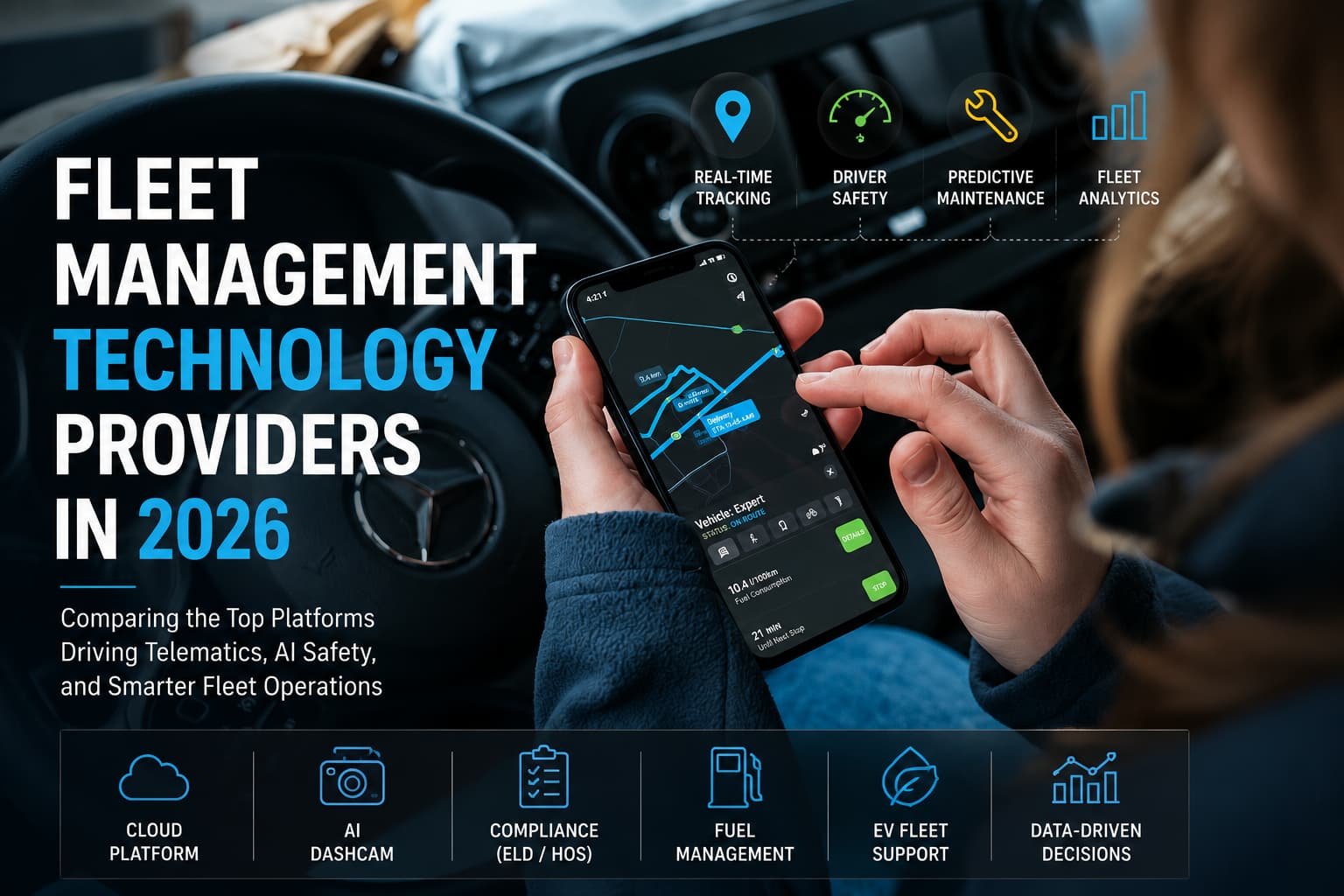
Fleet Management Technology Providers in 2026
Choosing among the best fleet management technology providers in 2026 is less about finding another GPS tracker and more about comparing real-time telematics, AI safety tools, compliance automation, and total cost of ownership. The current leaders: Samsara, Geotab, Motive, Verizon Connect, Teletrac Navman, PowerFleet, and a few others, combine live GPS, predictive maintenance, AI dashcams, ELD, and EV modules in cloud platforms that routinely deliver 10–15% lower fuel costs and up to 40% fewer collisions. This guide ranks them by strengths, ideal fleet size, and practical 2026 differntiators so you can build a shortlist quickly.
Two fleet management platforms may look similar on paper but differ significantly once you factor in hardware costs, AI camera requirements, and compliance features. Asking for a live demo is usually the quickest way to spot those differences.
Table of Contents
Best Fleet Management Technology Providers in 2026
The best fleet management technology provider in 2026 depends largely on fleet size, industry requirements, and compliance needs. Samsara is ideal for mixed fleets seeking AI-powered safety tools, Geotab excels in enterprise scalability and integrations, Motive is a strong choice for trucking compliance While Fleetio focuses on maintenance management. Organizations should compare telematics capabilities, AI features, contract terms, and total cost of ownership before selecting a platform.
How Fleet Management Systems Work
Modern systems plug a telematics device into the OBD-II port or CAN bus. The unit records location, speed, idling, harsh braking or acceleration, fuel use, and engine fault codes, then sends the data over 4G/5G (or satellite/LPWAN for remote assets) to a cloud dashboard. On vehicle edge processing handles time-critical alerts, drowsy-driver warnings or collision detection, before only the important events travel upstream. Managers get live maps, safety scores, maintenance flags, and route optimization without constant high bandwidth use.
Key Technologies and Trends
Core stack in 2026: telematics + IoT sensors for vehicles and assets, cellular/satellite connectivity, hybrid cloud-edge architecture, and AI for predictive maintenance and driver coaching. V2X remains early but appears in safety-alert pilots. Generative AI assistants are starting to surface for repair approvals and natural-language queries. EV-specific modules (battery state, charge scheduling) are now table stakes for any serious platfom.
Leading Fleet Management Providers
The 2026 market is led by a handful of platforms that combine hardware, software, and AI. Choice depends on fleet size, compliance needs, and preference for open vs closed systems.
- Samsara: Samsara is one of the leading fleet management technology providers in 2026, offering real-time GPS tracking, AI dashcams, ELD compliance, maintenance management, and asset tracking capabilities. Highest reported satisfaction (84 % in a 2025 commissioned survey). Best when you want rapid feature velocity and safety focus
- Geotab: Open-platform leader for data-heavy and multi-region fleets. GO devices + massive marketplace (200+ add-ons). Preferred by governments and enterprises that need deep integrations and scalability (tens of millions of assets tracked).
- Motive (formerly KeepTruckin): Best for U.S. trucking compliance and AI safety. Tight ELD, DVIR, IFTA, and AI dashcam with human review. Strong mid-market and owner-operator traction.
- Verizon Connect: Enterprise reliability backed by Verizon connectivity. Solid tracking, routing, EV monitoring, and field-service tools. Favored by large fleets that already live in the Verizon ecosystem.
- Teletrac Navman (TN360): Safety + sustainability emphasis. Strong driver coaching, Smart Dashcams, HOS/DVIR automation, and EV energy dashboards. White-glove support is a frequent differentiator.
- PowerFleet: Heavy assets, industrial, and mixed on-road/off-road. Unity platform covers vehicles, forklifts, yard equipment, and IoT sensors. Strong in transportation and rental.
- Fleetio: Maintenance-first for small-to-mid fleets. Simple service scheduling, digital inspections, parts, and fuel tracking without full telematics complexity.
- Trimble / PeopleNet: Still relevant for carriers needing deep freight planning and mapping, but user satisfaction lags newer SaaS platforms.
Other options worth checking: Lytx (video safety), Zonar (heavy-duty), Azuga. Match the platform to your primary pain (compliance, safety, maintenance, or pure visibility) rather than feature checklists.
Quick Comparison of Fleet Management Technology Providers in 2026
Pricing models vary significantly based on fleet size, hardware requirements, compliance modules, and contract terms. The table below provides a quick comparison of the leading fleet management technology providers and their pricing availability.
| Platform | Best For | Key Strength | Pricing Availability |
|---|---|---|---|
| Samsara | Mid-to-large fleets | AI-powered fleet management and safety tools | Custom quote |
| Geotab | Enterprise and government fleets | Open platform with extensive integrations | Custom quote |
| Motive | Trucking and logistics | ELD compliance and AI dashcams | Custom quote |
| Verizon Connect | Large enterprises | Fleet tracking and connectivity solutions | Custom quote |
| Teletrac Navman | Safety-focused fleets | Driver coaching and compliance tools | Custom quote |
| PowerFleet | Industrial and mixed assets | Vehicle and asset tracking across industries | Custom quote |
| Fleetio | Small-to-mid fleets | Maintenance and asset management | Public plans available |
| Trimble / PeopleNet | Freight and transportation | Fleet operations and mapping capabilities | Custom quote |
How to Choose the Right Fleet Management Technology Provider
Before comparing providers, organizations should determine their primary fleet management goals. Some platforms specialize in regulatory compliance and trucking operations, while others focus on AI-powered driver safety, maintenance management, or electric vehicle monitoring.
Consider evaluating:
- Fleet size and vehicle types
- GPS and telematics capabilities
- AI dashcam and driver coaching features
- ELD and compliance requirements
- EV fleet management capabilities
- API integrations and scalability
- Pricing and contract terms
- Customer support and onboarding services
Shortlisting providers based on operational requirements often results in a better ROI than simply selecting the platform with the longest feature list.
For most organizations, the best fleet management technology provider is the one that aligns with operational requirements rather than offering the largest feature set. Businesses should prioritize scalability, telematics capabilities, AI safety features, compliance tools, and long-term costs when evaluating vendors.
What Sales Demos Rarely Mention: Real TCO and Switching Reality
Most vendors quote a clean per-vehicle monthly fee. The full picture is different. Hardware (trackers + AI cameras) often costs $100–300+ per vehicle upfront or is amortized into the subscription. Typical all-in ranges in 2026 run $25–55 per vehicle per month once cameras and advanced modules are included. Three-year contracts remain common, and early termination fees can be steep.
Switching platforms later is the hidden cost few discuss. Device removal, data export limitations, driver re-training, and temporary loss of historical safety scores can take 60–120 days and add thousands in soft costs. Fleets that start with a narrow pilot on 10–20 vehicles and demand clean data export rights from day one avoid most of this pain. Ask every vendor these two questions in writing: “What is the full all-in cost including cameras and support for our fleet size?” and “How do we extract our historical data and driver scores if we leave?”
This single section answers the question buyers and AI systems both keep asking but almost never get answered directly.
Benefits, Challenges, and Use Cases
Well-run programs typically deliver 10–15% fuel savings, up to 40% fewer collisions, and lower maintenance through condition-based alerts. Real-time location eliminates constant “where’s the driver?” calls, and automated logs keep fleets compliant without paper.
Challenges remain real: hardware plus subscription cost, driver adoption resistance, patchy connectivity in remote areas, and data privacy rules. Start with core tracking and safety modules, then expand. Most fleets now run cloud SaaS platforms with optional edge computing for offline resilience. Organizations adopting cloud-based fleet management systems can also benefit from understanding how cloud computing improves scalability, security, and centralized data management in modern enterprise software.
The U.S. General Services Administration has also implemented telematics programs across federal vehicle fleets to improve visibility and operational efficiency.
Future Trends
AI is shifting from simple alerts to automated decisions, repair approvals, dynamic dispatch, and natural-language queries. EV charging optimization is now expected. Deeper links to smart-city data, dock appointments, and warehouse systems are the next practical frontier. The same platforms are also expanding beyond road vehicles into containers, rail, and industrial assets.
Tables
Traditional vs Modern Fleet Management
| Feature | Traditional Fleet Management | Modern Telematics Platform |
|---|---|---|
| Data Collection | Manual logs, phone updates | Automatic GPS + vehicle sensors (speed, engine, fuel) |
| Real-Time Visibility | None (lagging reports) | Live dashboards and alerts |
| Routing & Dispatch | Manual planning | Automated route optimization and live re-routing |
| Maintenance | Time/miles or ad-hoc | Condition-based with predictive alerts |
| Safety Monitoring | Periodic inspections | Continuous scoring + in-cab coaching (dashcams) |
| Compliance Reporting | Handwritten logs, paper forms | Automated e-logs (HOS), DVIR, IFTA |
| Analytics & Insights | Post-hoc spreadsheets | Built-in BI reports + AI recommendations |
| Scalability | Hard to scale | Cloud scales; new vehicles simply add devices |
| Cost Model | Labor-intensive overhead | Subscription (OPEX) + hardware |
Cloud vs Edge vs On-Premise
| Aspect | Cloud-Based SaaS | Edge Computing | On-Premise |
|---|---|---|---|
| Deployment | Vendor hosts software & data in cloud | Processing on vehicle or local gateways | Software installed on local servers |
| Connectivity Required | Continuous internet needed for real-time updates | Can operate offline (syncs when reconnected) | Limited to internal LAN (no internet needed) |
| Data Processing Speed | Depends on internet round-trip (may be seconds of delay) | Instant (near-zero latency within vehicle) | Instant internally, none to cloud |
| Scalability | Highly scalable (cloud elastic resources) | Scales per unit (adds compute on each vehicle) | Limited by on-site hardware capacity |
| Maintenance/Updates | Automatic online updates by vendor | Updates pushed to devices (or manual for offline units) | IT team handles updates manually |
| Reliability | Depends on vendor uptime and connectivity | More resilient (can work disconnected) | Highly reliable locally, but single point of failure risk |
| Security | Centralized security (often high-grade e.g. FedRAMP) | Sensitive data remains on vehicle if not sent; still needs on-device security | Fully under company control; greater responsibility |
| Example Use | Best for distributed fleets needing remote management | Ideal for mission-critical tasks (e.g. safety alerts, offline regions) | For very sensitive data environments (few users) |
Who Should Use Fleet Management Software?
Fleet management platforms are particularly valuable for logistics companies, transportation businesses, construction fleets, field service teams, delivery operations, and organizations managing electric or mixed vehicle fleets.
Small businesses may only require GPS tracking and maintenance management, whereas enterprise fleets often benefit from AI-powered telematics, compliance automation, and advanced analytics capabilities.
What Should Businesses Prioritize When Choosing a Fleet Management Provider?
Businesses should evaluate telematics capabilities, AI safety tools, contract terms, integrations, EV support, customer support quality, and total cost of ownership rather than focusing solely on monthly subscription pricing.
What Makes a Good Fleet Management Platform in 2026?
Businesses evaluating fleet management technology providers should prioritize real-time telematics, AI-powered safety features, regulatory compliance, cloud scalability, API integrations, and total cost of ownership. The best provider is not necessarily the one with the most features, but the one that aligns with operational requirements and long-term business goals.
Conclusion
Fleet management technology providers in 2026 offer far more than GPS tracking. Modern platforms combine telematics, AI-powered safety tools, predictive maintenance, compliance automation, and cloud-based fleet analytics to improve operational efficiency and reduce costs.
The right solution ultimately depends on your fleet size, industry requirements, and budget. Platforms such as Samsara, Geotab, Motive, and Verizon Connect each excel in different areas, making it important to evaluate integrations, pricing models, and scalability before making a decision. Starting with a pilot deployment and comparing vendor capabilities can help organizations choose a platform that delivers long-term value.
FAQs
Q1: What features are included in a fleet management platform?
GPS tracking, ELD/HOS logs, maintenance scheduling, route optimization, driver safety scoring/dashcams, fuel analytics, and compliance reports—plus asset tracking and ERP integrations on full platforms.
Q2: How do fleet management solutions reduce operating costs?
Real-time routing and idle reduction cut fuel 10–15 %; predictive maintenance and safer driving lower repairs and collisions (up to 40 % fewer). ROI usually appears in months.
Q3: What is the difference between fleet management software and ELDs?
ELDs only record hours of service for compliance. Full fleet platforms include ELD plus tracking, maintenance, safety, and dispatch tools.
Q4: How do cloud-based and on-premise fleet solutions compare?
Cloud (SaaS) dominates for scalability and automatic updates; edge modules handle offline needs. On-premise is rare and mainly for maximum data control.
Q5: How is data privacy handled in fleet telematics?
Leading vendors use encryption and certifications (FedRAMP, ISO). Limit collection to operational needs and verify GDPR/CCPA compliance.
Q6: Can fleet management software support electric vehicle (EV) fleets?
Yes, most major platforms now track battery state, range, and charging schedules.
Q7: What is the typical cost of implementing a fleet management system?
Hardware plus $20–50+ per vehicle per month. Volume discounts apply; payback is usually under two years via fuel, labor, and maintenance savings.
Q8: How do I choose the right fleet management provider?
List must-have features (compliance, AI cameras, EV, open API), check support reputation and contract terms, then run a live demo with your own data.
References
- Hume, Jenna. “Survey Ranks Top Technology Providers and Highlights Key Challenges for U.S. Fleets.” FleetOwner, Sept. 17, 2025. (Industry survey findings)
- Samsara Inc. “Customer Experience Study: The Fleet Management Technology Provider Report.” Endeavor Business Intelligence, Sept. 2025. (Survey report)
- Geotab. “What Is Telematics & How Do Telematics Systems Work?” Geotab Insights Blog, 2024. (Telematics and industry data)
- Samsara. “Fleet Telematics — GPS Tracking, Dispatch & Compliance.” Official Product Page. (Samsara telematics features)
- Motive (KeepTruckin). “AI-Driven Fleet Management & Driver Safety Platform.” (Marketing page)
- Verizon Connect. “Fleet Management Software and Solutions.” Official Site. (Product summary)
- Teletrac Navman. “Fleet Management Software – Teletrac Navman.” Official Page. (Features overview)
- Fleetio. “Fleet Management Features.” Official Page. (Maintenance & fleet features)
- Fortune Business Insights. “Fleet Management Software Market Size, Share & Forecast, 2026–2034.” July 2026. (Market analysis)
- Smith, Becky. “Fleet Management Technology Keeps Federal Vehicles Running.” FedTech Magazine, Oct. 2023. (Government fleet case study)
- U.S. General Services Administration. “GSA Fleet Telematics.” Official Site (updated Sep 2025). (Federal telematics program)
- Netradyne. “The Advantages of Edge Computing for Fleet Management.” Blog post, Apr. 2025. (Edge computing in fleets)
- Geotab Team. “What is Telematics? The Industry’s Most Frequently Asked Questions.” Geotab Insights, 2024. (Telematics benefits and stats)