

B2B Data Automation for Spanish SaaS Startups and Scaleups
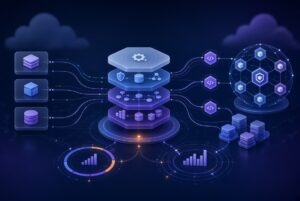
B2B data automation means connecting the systems a SaaS company runs on — CRM, billing, product usage data, and for security vendors, telemetry, so information moves between them without someone doing it by hand. In Spain, that plumbing is starting to matter more than most founders expect. The country’s tech ecosystem passed €125 billion in combined value in 2026, cybersecurity SaaS startups with 10–300 employees are increasingly caught up in NIS2 supplier requirements whether or not they’re directly regulated, and Spain’s data protection authority just published explicit rules for what happens when an automated system, not a person, makes the call on customer data. This guide covers how to pick an automation approach at each stage, and what Spain’s regulatory shifts actually require of it.
Who This Guide Is For
This guide is intended for founders, operations leaders, engineering teams, and compliance managers at Spanish B2B SaaS startups and scaleups. It covers business workflows such as CRM, billing, onboarding, and reporting, as well as security-focused pipelines used by cybersecurity vendors.
The appropriate approach depends on the company’s size, workflow complexity, data sensitivity, integration requirements, and available engineering resources. A small startup may need only a few reliable integrations, while a growing SaaS provider may require stronger access controls, audit logs, vendor reviews, and documented data-retention practices.
Why This Matters in Spain Right Now
Spain’s tech ecosystem has moved past the “get to product-market fit” stage — nearly half its tech-sector value now sits in companies founded in the last decade, and the conversation among investors has shifted to scaling and retention. At the same time, the compliance floor under automation has moved: the AEPD published detailed guidance on AI agents and GDPR in February 2026, and Spain still hasn’t finished transposing the EU’s NIS2 cybersecurity directive into national law. A founder automating data flows in Spain right now is choosing a tool and a compliance posture at the same time, whether they realize it or not — the sections below cover both.
What “B2B Data Automation” Actually Covers
The phrase gets used loosely, so it’s worth being specific about what it means inside a SaaS company:
- Lead-to-cash automation — syncing CRM (HubSpot, Pipedrive, Salesforce) with invoicing and accounting tools, common in Spain with platforms like Holded or Quipu that handle local tax requirements.
- Product-usage-to-billing pipelines — feeding metered or seat-based usage data into billing systems without manual reconciliation.
- Customer onboarding workflows — provisioning accounts, permissions, and welcome sequences across multiple systems on signup.
- Security data pipelines — for cybersecurity vendors specifically, ingesting logs and telemetry into SIEM/SOAR platforms and automating parts of incident response.
- Reporting and RevOps automation — pulling data from disparate tools into one place so finance and leadership aren’t reconciling numbers by hand.
Each workflow may create different data-protection and security considerations when personal or confidential information is involved. The appropriate architecture therefore depends not only on the workflow’s technical requirements, but also on the data being processed, the parties involved, and the controls needed to manage access, retention, and failures.
The Spanish SaaS and Scaleup Landscape in 2026
The following figures come from the 2026 Spanish Tech Ecosystem Report (Dealroom, with BBVA Spark, Kfund, Endeavor, and others) and the Fundación Innovación Bankinter/ICEX startup observatory.
| Metric | 2026 figure | Note |
|---|---|---|
| Combined tech ecosystem value | €125 billion | 2.3x growth since 2020; 8th largest in Europe |
| Total VC raised by Spanish startups, 2025 | €3.1 billion | Down 3% from €3.2B in 2024 |
| Share of 2025 VC going to Madrid or Barcelona | ~74% | More than €2.3B of the €3.1B total |
| Estimated number of startups | 12,000+ | Per ecosystem tracking as of mid-2026 |
| Estimated number of scaleups | 480+ | Companies past early formation, scaling headcount and revenue |
| Recognized unicorns | 18 | Across sectors, not limited to SaaS |
| AI-founded startups since 2021 | Almost 1 in 5 | Roughly double the pre-2021 rate, per Dealroom |
The concentration of investment in Madrid and Barcelona is relevant for founders outside those markets because access to funding, specialist hiring, and business networks may vary by location. However, investment concentration does not mean that companies in other Spanish regions cannot build or scale successfully.
Why Cybersecurity SaaS Startups with 10–300 Employees Face Different Rules
A cybersecurity SaaS company in Spain with 10–300 employees operates under a materially different set of pressures than a generic B2B SaaS firm of the same size. Two factors drive the difference. First, it is far more likely to fall within NIS2 scope—either as a direct entity or as a supplier to one. Second, its product is often itself a data-automation pipeline: SIEM ingestion and SOAR tooling are automation by definition.
Spain’s domestic cybersecurity landscape includes established players such as S2 Grupo (Valencia, founded 1999, focused on cyber-intelligence and critical-systems operations), CounterCraft (San Sebastián, cyber-deception and threat detection), and Buguroo (fraud and threat intelligence). The country’s best-known success story, Devo, illustrates both the opportunity and the structural ceiling. Founded in Madrid in 2011 as LogTrust, it built a cloud-native SIEM/SOAR platform, reached unicorn status after a $250 million round in 2021, and relocated its headquarters to Cambridge, Massachusetts to secure the growth-stage capital required. Several of Spain’s most capital-intensive cybersecurity exits have similarly shifted their centre of gravity abroad. This pattern is precisely what the Startup Law (Law 28/2022) and instruments such as ENISA financing aim to reverse.
As of mid-to-late 2026, Spain had still not completed transposition of the NIS2 Directive, missing the October 2024 EU deadline by a wide margin. On 8 July 2026 the European Commission referred Spain (along with Ireland, France and the Netherlands) to the Court of Justice of the EU for failure to notify full transposition measures. The draft legislation—the Ley de Coordinación y Gobernanza de la Ciberseguridad—was approved by the Council of Ministers in January 2025 and remains in parliamentary process. Once enacted, INCIBE and the Centro Criptológico Nacional (CCN) are expected to share supervisory responsibility.
NIS2 generally captures companies with 50 or more employees or more than €10 million in revenue that operate in one of 18 designated sectors, including digital infrastructure and managed ICT/security services. Smaller suppliers are pulled in indirectly when regulated customers impose contractual cybersecurity guarantees. That commercial pressure is already visible: INCIBE recorded 122,223 cybersecurity incidents in Spain in 2025, a 26 % year-on-year increase. The incident volume, not the precise status of the statute, is what is driving contractual demands today.
Do You Have to Comply With NIS2 in Spain Yet?
No Spanish law formally requires it yet — but if you sell to a regulated customer, you’re already being asked to prove it. Spain missed the EU’s October 2024 NIS2 deadline and, as of September 2026, still hasn’t enacted its national cybersecurity law. In practice:
- No domestic legal penalty currently applies to a Spanish company outside the direct 50-employee / €10M threshold.
- The EU directive has applied since October 2024 regardless of Spain’s delay, and carries legal force against public bodies already.
- Regulated customers — banks, healthcare, energy, public administration — are already contractually requiring NIS2-equivalent security proof from suppliers, law or no law.
- Once Spain’s law passes, in-scope companies typically get a short adaptation window, so building the evidence base now avoids a scramble later.
Choosing a Data Automation Approach: Build, iPaaS, Embedded iPaaS, or Open Source
The right category depends on team size, whether you’re automating internal operations or building integrations your customers touch, and how much engineering time you can spare.
| Approach | Best fit | Engineering lift | Typical cost signal | Main limitation |
|---|---|---|---|---|
| Build in-house | Very early stage, one or two critical integrations | High upfront, ongoing maintenance | No license fee, but real engineer-hours indefinitely | Maintenance cost compounds and rarely gets budgeted for |
| General-purpose iPaaS (Workato, Boomi, Tray) | Internal operations — RevOps, finance, onboarding | Low-to-medium, largely no-code | Mid-to-high monthly subscription | Enterprise pricing tiers fit poorly below ~50 employees |
| Embedded iPaaS (Prismatic, Paragon, Albato) | Offering integrations to your own customers | Medium — developer setup, then self-serve | Usage- or tier-based, scales with customer count | Adds an abstraction layer; still needs governance over customer data flow |
| Open-source / self-hosted (n8n) | Technical teams wanting control and lower cost | Medium-to-high | Low direct cost, but you run and secure it yourself | Your team owns the security posture, not a vendor |
Match the Tool to the Data Flow
An iPaaS platform is not a universal replacement for data engineering infrastructure. Low-volume CRM updates, onboarding workflows, and finance notifications may work well with an integration platform. High-volume product events, security telemetry, and complex transformations may require message queues, stream processing, workflow orchestration, or a dedicated data pipeline.
The key questions are how much data moves through the system, how quickly it must be processed, whether delivery must be guaranteed, how failures are retried, and which team owns ongoing maintenance.
The Compliance Layer You Can’t Automate Around
Most comparisons of automation tools stop at features and pricing. That’s a mistake in Spain right now.
The AEPD’s February 2026 guidance on AI agents and GDPR makes one point central: when an automated agent handles personal data autonomously, legal responsibility stays with whoever deployed it and set its purpose. Autonomy doesn’t dilute accountability. For a company automating a pipeline that touches customer or employee data, that means:
- If your automation platform uses an AI agent to route, enrich, or decide anything about personal data, you’re the controller or processor of record — regardless of how autonomous the tool’s marketing claims it is.
- The AEPD specifically flags persistent memory in agentic systems as a risk: if a tool remembers context across runs, that memory needs retention limits and has to support access and erasure requests.
- Not every automated action counts as “automated decision-making” under GDPR Article 22 — the AEPD ties this to the decision’s effect and how much real human review happens, not to whether a human technically clicked approve.
- A Data Protection Impact Assessment is required in practice more often than founders assume — the AEPD’s broader guidance treats something as routine as automated invoice classification as in-scope once personal data appears on those documents.
None of this takes automation off the table. It changes the due-diligence question from “does it connect the systems we need” to “where is the data retained, for how long, and can we produce an audit trail.”
Example: Automating Customer Data Between a CRM and Billing Platform
Suppose a SaaS company automatically sends customer information from its CRM to a billing platform. Before implementing the workflow, the team should document which fields are transferred, why they are needed, which vendors process the information, who can access it, how failures are handled, and how long the records are retained.
If an AI system is later added to classify, enrich, or make decisions using that data, the company should reassess the processing purpose, system permissions, human involvement, and applicable data-protection requirements. The compliance assessment should be based on the actual workflow rather than on the use of the word “AI” alone.
Common Data Automation Mistakes
Building isolated point-to-point integrations
A company may add one integration at a time without documenting ownership, authentication, error handling, or dependencies. As the number of workflows increases, maintenance becomes more difficult.
Moving personal data without a clear processing map
Teams may know which systems are connected but lack a current record of what information is transferred, why it is transferred, where it is stored, and how long it is retained.
Treating vendor security as a connector feature
A platform’s connector count does not demonstrate that it meets the company’s security requirements. Vendor reviews should also consider access controls, logging, data location, subprocessors, encryption, incident response, and contract terms.
Assuming customer requirements are identical to legal requirements
A customer may request security controls or evidence through a contract even when the supplier is not directly subject to the same statutory requirements. Companies should distinguish legal obligations from customer-specific contractual conditions.
Automating Before Documenting the Existing Process
A workflow should not be automated simply because it is repetitive. Teams should first understand the current process, identify unnecessary steps, define the expected result, and establish how errors will be detected. Automating an unclear process can transfer existing inefficiencies into a system that is harder to troubleshoot.
When Full Automation May Be Premature
Automation has a cost curve, and it runs the other direction below a certain size. Under roughly 15–20 employees, before product-market fit is settled, a full automation layer is usually premature, the integrations that matter at 15 employees are rarely the ones that matter at 60.
Automation should be evaluated against workflow volume, error frequency, integration complexity, data sensitivity, and the cost of manual work—not headcount alone.
A small SaaS company may benefit from a narrow automation for lead handoff, invoicing, onboarding, or support notifications. A larger company may still delay a broader platform decision if its workflows are unstable, poorly documented, or difficult to measure.
Start with one limited use case. Document the existing process, define a measurable outcome, monitor failures, and calculate the maintenance effort. Expand only when the workflow is sufficiently understood and the team can support it over time.
A Practical B2B Data Automation Checklist
Before implementing or expanding an automation workflow, review the following areas:
- Map the data flow: Document the source system, destination system, data fields, processing purpose, and responsible team.
- Classify the data: Identify whether the workflow handles personal data, confidential business information, security telemetry, or regulated information.
- Choose the architecture: Compare in-house development, iPaaS, embedded integrations, event-driven pipelines, and self-hosted tools based on the actual workload.
- Review access controls: Use least-privilege permissions, separate service accounts where appropriate, and remove unused credentials.
- Define failure handling: Document retries, duplicate-event handling, error alerts, manual recovery, and ownership.
- Check vendor processing terms: Review data location, subprocessors, retention, security controls, and contractual responsibilities.
- Assess compliance requirements: Determine whether GDPR, sector-specific requirements, customer contracts, ENS-related conditions, or NIS2-related obligations may apply.
- Create audit evidence: Keep records of changes, access, processing activity, failures, and relevant security reviews.
- Measure the result: Track processing time, failure rate, manual intervention, and operational cost before expanding the workflow.
What’s Next for Spanish SaaS Companies
Spain’s NIS2 implementation remains an important regulatory development. On 8 July 2026, the European Commission announced that it had referred Spain to the Court of Justice of the European Union for failing to notify full measures transposing the directive.
SaaS companies should monitor official implementation updates rather than rely on a fixed assumption about when every obligation will begin. They should also distinguish direct legal scope from customer security requirements, contractual controls, and voluntary preparation.
The AEPD’s guidance on agentic AI provides another reason to review privacy, access control, retention, transparency, and auditability when automated systems process personal data. These assessments should be based on the actual workflow and the organization’s role in the processing.
Final Takeaways
The tooling decision and the compliance posture are the same decision now, not two separate ones — that’s the shift most existing guides on this topic miss. Cybersecurity SaaS companies in the 10–300 employee range feel it first, since their product is automation and their customers are increasingly regulated. Building in data-retention discipline and an audit trail before you’re forced to is cheaper than retrofitting it once a specific law is on the books — which, in Spain, is now a matter of when, not if.
FAQs
What is B2B data automation for a SaaS company?
B2B data automation connects systems such as CRM, billing, product analytics, support, and security tools so information moves between them with less manual work.
What are common B2B data automation use cases?
Common use cases include lead-to-cash workflows, customer onboarding, product-usage-to-billing pipelines, reporting, customer support, and security telemetry processing.
Is data automation subject to GDPR in Spain?
Yes, whenever the workflow processes personal data, which includes most customer, billing, and employee records.
Does NIS2 apply to Spanish SaaS startups?
Directly, only above 50 employees or €10M revenue in specific sectors, smaller vendors get pulled in through customer contracts regardless.
What is the difference between iPaaS and embedded iPaaS?
An iPaaS platform commonly supports integrations and workflows for an organization’s internal operations. Embedded iPaaS allows a software provider to offer integration capabilities within its own product for customers.
Do automated workflows always require a DPIA?
No. A DPIA is required when processing is likely to create a high risk to individuals’ rights and freedoms. The decision depends on the nature, scope, context, and purpose of the processing.
How should SaaS companies evaluate automation vendors?
Review integration capabilities, data location, subprocessors, access controls, logging, retention, security documentation, failure handling, pricing, and ongoing maintenance requirements.
When should a SaaS startup adopt a data automation platform?
Most teams feel the need around 15–20 employees, once three or more systems need manual syncing — not at a fixed headcount.
References
- Spanish Tech Ecosystem Report 2026 — ecosystem valuation, investment, and technology-market context.
- NIS2 Directive implementation in Spain — European Commission implementation status.
- European Commission refers Spain to the Court of Justice over NIS2 transposition — July 2026 update.
- AEPD: Agentic Artificial Intelligence from the Perspective of Data Protection — February 2026 guidance.
- Official company websites and current corporate sources used to verify any company-specific descriptions.
- Official legal and government publications used to verify Spanish cybersecurity, privacy, and startup-policy claims.