


Enterprise Service Repository: Definition, Examples & Best Practices
An Enterprise Service Repository (ESR) is a design-time catalog that stores and governs service contracts, schemas, mappings, ownership information, and policies. It can contain definitions such as OpenAPI, AsyncAPI, WSDL, message mappings, and data types, giving enterprise teams a central place to discover and reuse existing interfaces instead of creating duplicate contracts.
An ESR is primarily a design-time governance system, not a runtime service-discovery mechanism. It does not route traffic. It answers three questions many large integration and AI environments eventually face:
- Does this interface already exist?
- Who owns it and is it still approved?
- What breaks if we change it?
As organizations adopt AI agents and automated workflows that can invoke APIs and other enterprise services, the need for accurate service inventories and clear ownership is becoming more important. A governed repository can help teams identify approved interfaces, understand their contracts, and apply lifecycle and access policies before services are reused or exposed to new consumers.
ESR in one sentence A design-time metadata catalog of service contracts and policies that prevents duplicate interfaces and provides a governed source of service metadata that AI-enabled systems can use when discovering approved capabilities.
Quick facts
- Type: Design-time metadata store (not runtime)
- Stores: Contracts (OpenAPI/WSDL/AsyncAPI), schemas, mappings, ownership, policies, lifecycle state
- Does not store: Live endpoints or business data
- Classic tools: SAP ESR, IBM WSRR, Oracle Enterprise Repository
- Modern equivalents: Governed API and service catalogs
- Closest confusable term: Service Registry (runtime location only)
Table of Contents
How Enterprise Service Repositories Work
An ESR is populated by importing or modeling service contracts (OpenAPI, AsyncAPI, WSDL, JSON Schema, message mappings). Each entry typically contains:
- Data types and message structures
- Service interface definition (sync/async, request/response or event)
- Mapping/transformation rules between systems
- Ownership, version, lifecycle state, and policy tags (security, compliance, SLA)
Once registered, architects and developers search the repository before building anything new. If a matching contract exists they reuse it; if not they create one under governance rules. Changes are versioned. When ready, the contract is published to runtime systems (API gateway, service mesh, or registry).
A typical ESR workflow looks like this:
Define → Register → Govern → Reuse → Publish → Monitor
Teams first define the service contract, register it in the repository, assign ownership and governance metadata, and make the approved definition available for reuse. When the service is ready for deployment, its contract and related metadata can be used by the appropriate runtime systems, such as an API gateway, registry, or service mesh.
This separation is important: the ESR governs the definition and lifecycle of a service, while runtime platforms handle traffic, availability, and service discovery.
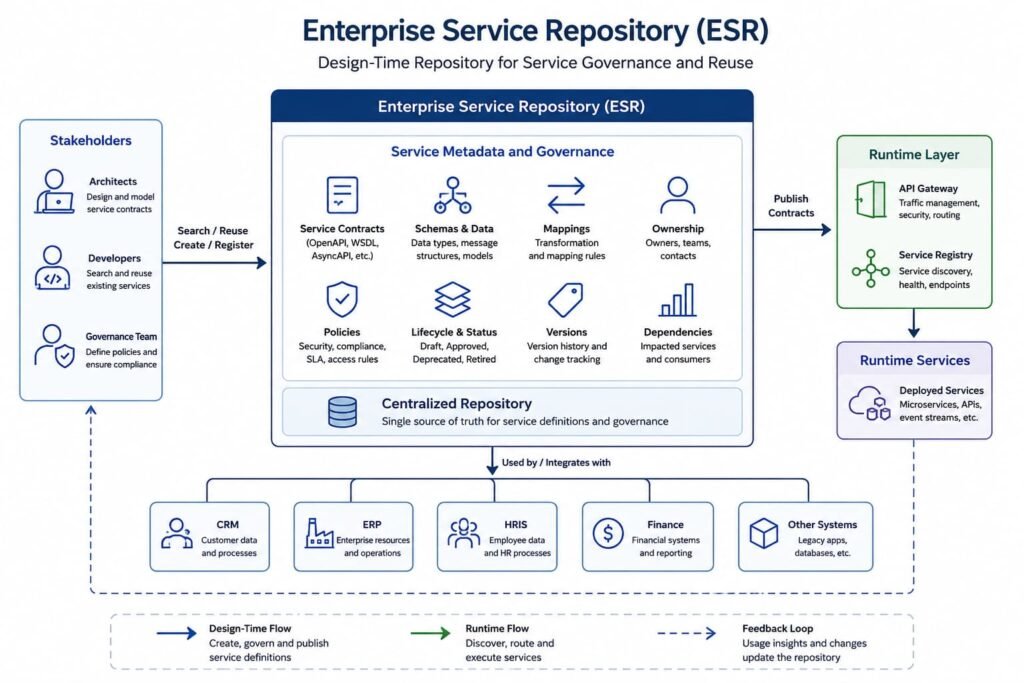
Enterprise service repositories become especially useful when interfaces connect ERP, CRM, finance, or supply-chain systems, because a change to one shared service contract can affect multiple downstream workflows. For example, teams integrating mobile or web applications with NetSuite should first understand the underlying ERP implementation requirements before designing the integration layer.
A pure design-time repository does not route application traffic or replace runtime service discovery. However, some products combine repository and registry capabilities. IBM WebSphere Service Registry and Repository (WSRR), for example, provides both registry and repository functions and can support runtime retrieval of service metadata and resources.
The distinction is therefore architectural: the repository side manages service definitions, metadata, and governance, while registry, gateway, or runtime components handle discovery and execution.
Modern API and agent catalogs are also extending traditional service governance to AI-facing tools and agents. Recording whether an interface is approved for AI-agent access can help organizations distinguish controlled automation from unmanaged agent sprawl.
Service Registry vs. Service Repository
It helps to contrast an ESR with a Service Registry, since the two terms are often used interchangeably but solve different problems. A service registry typically focuses on runtime discovery: where service instances are available and how consumers can locate them. An ESR tracks what a service is: its contract, schema, owner, and version history. One is about locating a service; the other is about governing it. Here’s how they break down:
A simplified comparison is below. Notice that both concepts “track” services, but the ESR covers much more background detail and governance:
| Feature | Service Registry | Enterprise Service Repository |
|---|---|---|
| Purpose | Discover and locate running service instances at runtime (dynamic lookup). | Catalog and govern service definitions at design time (static metadata). |
| Content Stored | Service endpoints/URLs, health status, basic metadata. | Service contracts (WSDL/OpenAPI), data schemas, message mappings, policies. |
| Managed By | Often built into microservice frameworks (Eureka, Consul, cloud discovery). | Usually part of enterprise integration/SOA tools (SAP PI/PO, IBM, Oracle). |
| Scope of Information | Runtime information (location of live instances). | Design-time information (interfaces, versions, documentation). |
| Governance | Minimal (focus on technical discovery). | Rich (includes ownership, versioning, policies, audit trails). |
| Users/Clients | Service consumers at runtime, routers/load balancers. | Architects, developers, integration specialists. |
| Typical Examples | Netflix Eureka, AWS Cloud Map, Kubernetes DNS. | SAP Enterprise Services Repository, IBM WSRR, Oracle Enterprise Repository. |
In short: the registry answers “where is it right now?” The repository answers “what is it, who owns it, and is it still valid?” Most mature organizations need both. The registry keeps traffic flowing; the repository keeps the architecture from rotting.
Do You Still Need an ESR If You Already Have an API Gateway or Service Mesh?
Yes, because they solve different problems and most teams don’t realize it until something breaks. An API gateway routes and secures traffic at runtime; a service mesh handles service-to-service communication in production. Neither one tells you what a service actually does, who owns it, or whether five other teams already built something similar. That’s the gap an ESR closes.
In practice, teams that skip the ESR and rely only on a gateway or mesh tend to hit the same wall: nobody can answer “does this interface already exist?” without asking around in Slack. The gateway knows the service is running. It has no idea it’s a duplicate.
The honest answer: if you have fewer than a few dozen services and a small team, a well-maintained internal wiki or API catalog can substitute for a formal ESR. Past that scale, or the moment AI agents start calling your internal services autonomously, the lack of a governed, searchable repository stops being a minor inconvenience and starts being a security and duplication problem.
Do you still need an ESR when you already have OpenAPI specs in Git?
Git can remain the source-control system for OpenAPI, AsyncAPI, WSDL, and schema files. An ESR or modern API catalog adds another layer: searchable metadata, ownership, lifecycle state, dependencies, governance attributes, and visibility across teams.
The two therefore solve different problems rather than replacing each other. Git manages changes to the specification files; the repository or catalog helps the wider organization understand, govern, and reuse the interfaces those files describe.
When You May Not Need an Enterprise Service Repository
Not every organization needs a dedicated ESR.
A small engineering team with a limited number of APIs may be able to manage service definitions using Git, an API catalog, documentation, and existing CI/CD governance. The overhead of introducing a formal repository may not be justified if there are few services, limited integration dependencies, and a single team responsible for them.
An ESR or governed service catalog becomes more valuable as the number of teams, interfaces, consumers, compliance requirements, and autonomous service consumers increases.
The practical question is not whether an organization is large enough to buy an ESR. It is whether teams can reliably answer what a service does, who owns it, which version is approved, and what depends on it without relying on informal documentation.
Common Enterprise Service Repository Solutions
Several enterprise tools and platforms implement a service repository as part of their integration/Governance offering. Below are representative examples:
Classic enterprise repositories
| Solution | Primary role |
|---|---|
| SAP Enterprise Services Repository | Design-time SOA/service definitions |
| IBM WebSphere Service Registry and Repository | Registry + repository + governance |
| Oracle Enterprise Repository | SOA/API governance and asset repository |
SAP documentation explicitly describes ES Repository as a design-time repository for SOA assets, while IBM describes WSRR as both a registry and repository. Oracle describes Enterprise Repository as a foundation for API lifecycle management and SOA governance.
Modern related platforms
Modern platforms often provide related catalog, governance, or discovery capabilities rather than functioning as traditional ESRs.
| Platform | What it actually does |
|---|---|
| Google Apigee API hub | API catalog, lifecycle management and governance |
| Google Cloud Agent Registry | Catalog and governance for agents, MCP servers, tools and endpoints |
| AWS Cloud Map | Runtime service discovery |
| Tanzu Service Registry | Runtime service discovery |
For instance, SAP’s ESR (used in PI/PO) is a central design-time repository where developers model every interface, data type, and message flow. After defining a “CreateOrder” message and mappings in the ESR, the integration director can wire up the source and target systems. IBM’s WebSphere Service Registry and Repository (WSRR) is both a registry and repository: it stores service metadata (WSDL, XSD, policies) as entities, and at runtime integration flows can query it for endpoint details via lookup nodes. Oracle’s Enterprise Repository works alongside its Service Registry to give a governance dashboard: it automatically discovers existing services and categorizes them, tracks policies over the SOA lifecycle, and reports on reuse statistics.
In modern microservices environments, lighter-weight registries are common. For example, VMware’s Tanzu Enterprise Service Registry (based on Netflix Eureka) focuses on dynamic registration of microservices, often using DNS or API queries for discovery. AWS’s Cloud Map provides similar capabilities in the cloud: developers register service instances (via DNS or API) and consumers discover those instances programmatically.
Benefits of an Enterprise Service Repository
- Stops duplicate interfaces. The most common and expensive failure mode in large enterprises is five teams independently inventing slightly different “GetCustomer” contracts.
- Provides governed service metadata that can support AI agents and automated workflows.
- Makes impact analysis possible. Change one shared schema and you immediately see every consumer.
- Creates an auditable ownership record. Critical for regulated industries and for any organization letting autonomous systems call internal services.
Everything else (faster onboarding, consistent data types, lifecycle tracking) is a side-effect of the four points above.
Challenges and Limitations of an Enterprise Service Repository
- Governance tax is real. If the repository is not kept current it becomes worse than no repository.
- Tool lock-in still exists with classic SOA platforms (SAP, older IBM/Oracle). Modern API catalogs reduce but do not eliminate this.
- Scope decisions are hard. Do you catalog only APIs, or also events, AI tools, and batch jobs? Unclear rules produce either empty or bloated repositories.
- It does not replace runtime discovery. You still need a registry, gateway, or mesh for live endpoints.
The ESR pays off only when the organization is willing to treat contract ownership as a first-class responsibility.
Best practices that actually matter
The most effective ESR implementations make governance part of the development workflow rather than creating another documentation task:
- Require new governed interfaces to be registered before they are promoted to production or exposed through approved gateways.
- Require ownership and data-classification tags on every entry.
- Automate registration from CI/CD or API design tools so the repository stays current.
- Explicitly mark which contracts AI agents are allowed to discover and call.
- Run a quarterly “dead contract” review—deprecate or archive anything unused.
- Treat the ESR as the source of truth for impact analysis, not as optional documentation.
Common Misconceptions
Several misunderstandings can arise around ESRs:
- “It’s only for SOAP/WSDL.” Historically, ESRs grew from XML-based SOA, but modern ESRs also handle REST APIs, JSON schemas, and even AI agent endpoints. They are metadata-agnostic. What matters is cataloging the contract of a service, regardless of protocol.
- “An ESR replaces a database or data warehouse.” An ESR does not store business data. It holds metadata about interfaces. For example, an Enterprise Data Repository (EDR) houses transactional data; an ESR defines how to move that data between systems. Confusing the two leads to architecture errors.
- “Service Registry and ESR are the same thing.” As noted, these serve different needs. A registry answers “where can I find this service right now?”, while an ESR answers “what is this service, who owns it, how is it structured?”. Both may exist together.
Future of Enterprise Service Repositories
The traditional ESR is evolving from a standalone SOA repository into a broader service and API governance layer.
Modern organizations increasingly need to catalog REST APIs, event-driven interfaces, service dependencies, and AI-accessible capabilities alongside traditional SOAP and WSDL definitions. API catalogs and service catalogs are therefore taking on some of the functions historically associated with ESR platforms.
AI introduces another reason to maintain accurate service metadata. If an AI agent can discover and invoke enterprise tools, organizations need to know which capabilities exist, who owns them, what data they expose, and whether they are approved for automated use.
This does not mean every organization will deploy a traditional ESR. Instead, ESR capabilities are increasingly being incorporated into API management, service catalogs, developer portals, and governance platforms.
The underlying requirement remains the same: maintain a reliable, searchable record of enterprise services and their contracts so teams can reuse approved capabilities without losing control over security, ownership, and lifecycle management.
Final Thoughts
An Enterprise Service Repository isn’t a tool you buy off the shelf and forget. Its value depends on the discipline behind it. The repository itself just holds metadata; the value comes from teams actually checking it before building something new, and from someone owning the job of keeping it current.
That said, the calculus is shifting. A few years ago, the case for an ESR was mostly about avoiding duplicate work across dev teams. Now, with AI agents increasingly calling internal services on their own, an unmanaged sprawl of undocumented interfaces is a governance risk, not just an inefficiency. Whether you adopt a full platform like SAP’s ESR or IBM’s WSRR, or start lighter with a well-maintained API catalog, the underlying question is the same: if someone — human or AI — needs to find out what a service does and who owns it, can they get an answer in under a minute? If not, that’s the gap an ESR is built to close.
FAQs
Q: What is an Enterprise Service Repository (ESR)?
A: A centralized, design-time catalog of service interfaces, schemas, and mappings — not the services or data themselves.
Q: How is an ESR different from a Service Registry or API Gateway?
A: A registry tracks live, running endpoints; a gateway routes traffic. An ESR catalogs the design-time contract — what the service is, not where it’s running.
Q: Who actually uses an ESR?
A: Enterprise architects, integration teams, and developers — mainly during system design, before anything is deployed.
Q: What’s the biggest benefit of using one?
A: Reuse. Teams can find and reuse existing service definitions instead of rebuilding the same interface repeatedly.
Q: Can microservices or cloud-native teams use an ESR?
A: Yes — via API catalogs or tools like AWS Cloud Map and Tanzu Service Registry, which apply ESR principles to containerized services.
Q: Is an ESR the same as a data repository?
A: No. An ESR stores metadata about how data moves between systems, not the business data itself.
References
- SAP Help Portal. Managing Services in the Enterprise Services Repository. SAP, accessed 2026. .
- IBM Documentation. WebSphere Service Registry and Repository. IBM, 2020. .
- IBM Documentation. Importing objects into the Enterprise Service Repository. IBM, 2025. .
- Oracle. Oracle Enterprise Repository Overview. Oracle, 2013. .
- Red Hat. What is a service registry? Red Hat, Aug. 2021. .
- VMware (Broadcom). Enterprise Service Registry (Spring Cloud). VMware Tanzu, 2026. .
- AWS Documentation. AWS Cloud Map – Service Registry. Amazon, 2026. .