

Enterprise IT Infrastructure Product Classification
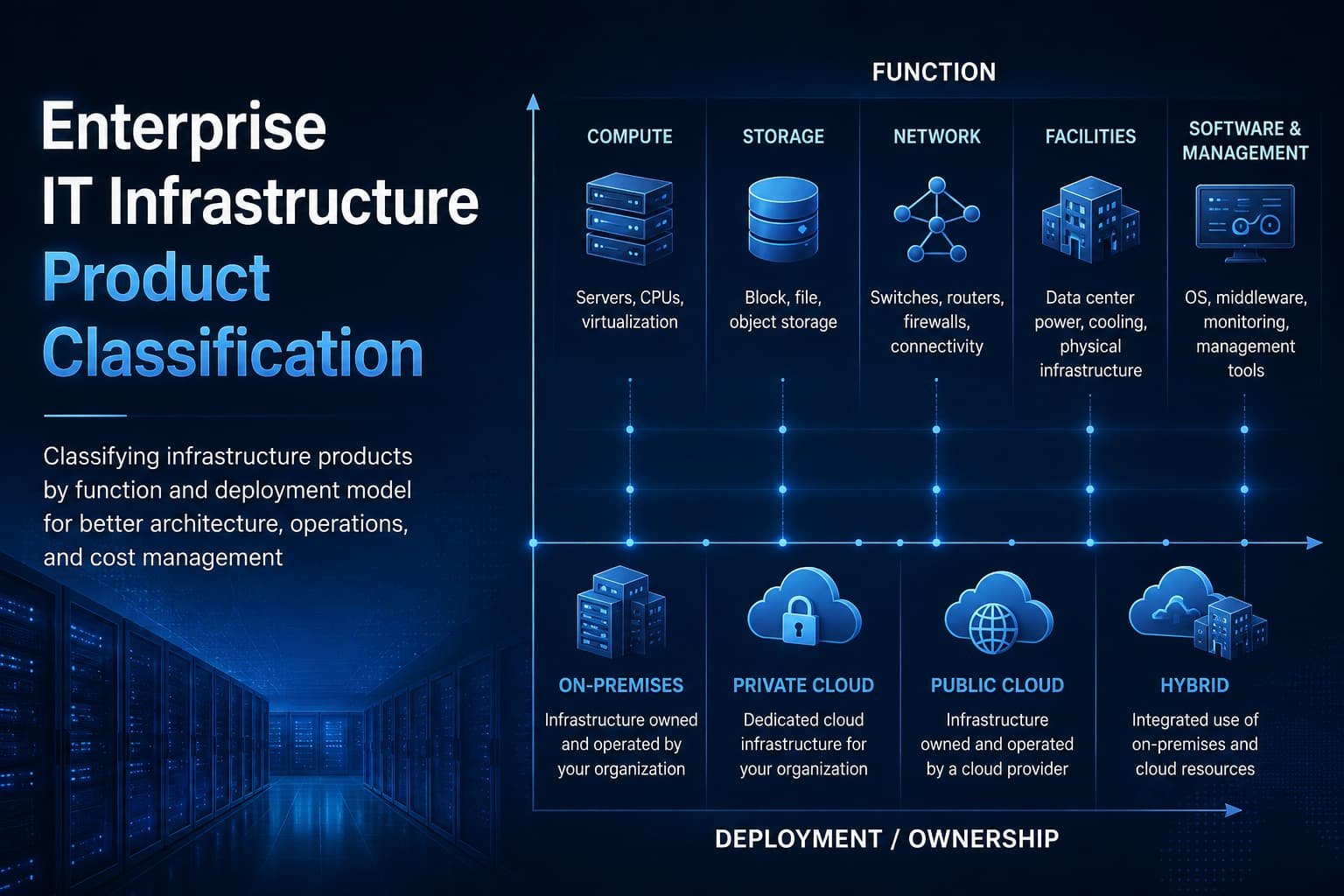
Enterprise IT infrastructure product classification is the systematic grouping of hardware, software, and cloud resources—such as servers, storage systems, switches, virtualization platforms, and managed services—into functional and deployment categories. A consistent classification helps teams maintain accurate inventories, allocate costs, compare infrastructure options, and identify gaps when designing or modernizing enterprise environments.
There is no universal classification scheme. A practical enterprise approach is to classify infrastructure across at least two primary axes: function and deployment model. Secondary frameworks, such as the TBM Council’s Technology Resource Towers, add a cost-management perspective.
Table of Contents
The Two Axes of Enterprise IT Infrastructure Classification
The first axis describes what the infrastructure does:
- Compute: servers, processing hardware, virtualization
- Storage: SAN, NAS, object storage, and backup systems
- Network: switches, routers, firewalls, wireless, and SD-WAN
- Data center and facilities: racks, power, cooling, and physical security
- Software and management: operating systems, middleware, monitoring, and orchestration
The second axis describes how the infrastructure is deployed and managed:
- On-premises: infrastructure owned and operated by the organization
- Private cloud: dedicated cloud infrastructure operated for one organization
- Public cloud: infrastructure resources delivered by a cloud service provider
- Hybrid: a combination of on-premises, private-cloud, and public-cloud resources
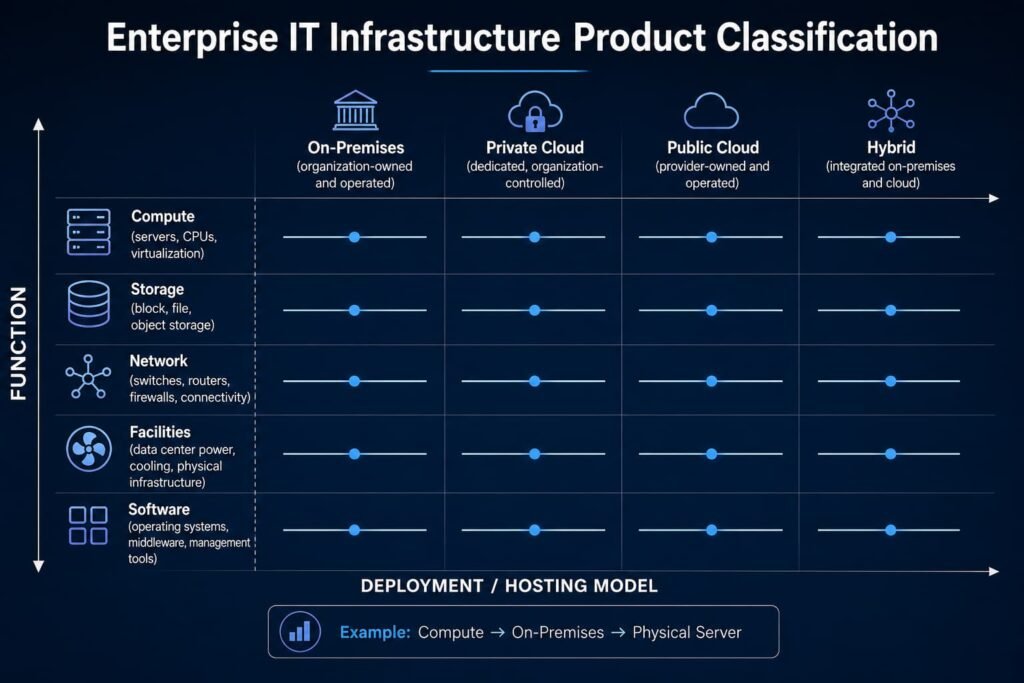
These axes work together rather than replacing one another. A physical server, for example, can be classified as Compute → On-premises → Data Center, while a virtual machine running on AWS can be classified as Compute → Public Cloud.
This multi-axis approach is more useful than forcing every product into a single category. Architecture teams usually care about function, migration and FinOps teams care about deployment and ownership, and finance teams may add a cost-allocation category.
Example of Two-Axis Classification
The two-axis model becomes easier to apply when you classify real infrastructure products. For example:
| Infrastructure product | Function | Deployment model | Additional tag |
|---|---|---|---|
| Physical rack server | Compute | On-premises | Data center |
| AWS EC2 instance | Compute | Public cloud | Cloud |
| SAN storage array | Storage | On-premises | Data center |
| Cloud object storage | Storage | Public cloud | Cloud |
| Data-center switch | Network | On-premises | Data center |
| Kubernetes cluster | Compute / Management | Hybrid or cloud | Container platform |
This approach prevents a common classification problem: treating “cloud,” “compute,” and “storage” as mutually exclusive categories. Function describes what the resource does, while deployment describes where or how it is delivered.
How Many Categories of Enterprise IT Infrastructure Are There?
There is no fixed number; it depends on the purpose.
A practical functional taxonomy can use five to six core categories:
- Compute — servers, processing hardware, virtualization
- Storage — SAN, NAS, object, and backup systems
- Network — switches, routers, firewalls, wireless, SD-WAN
- Data Center / Facilities — power, cooling, racks, physical security
- Software & Management — OS, middleware, monitoring, orchestration
- Cloud & Hosted Services — IaaS, PaaS, managed infrastructure, and other cloud-delivered resources
SaaS is usually classified separately when an organization is building a broader technology portfolio rather than an infrastructure taxonomy. IaaS and PaaS are more directly relevant to infrastructure because they provide computing, storage, networking, or application-development resources.
The TBM Council’s Technology Resource Towers provide another classification lens, grouping technology resources by function for cost management, benchmarking, and technology planning. The current TBM Taxonomy also accounts for areas such as Compute, Storage, Data, Network, Security, Smart Devices, and IoT. NIST’s cloud model distinguishes between the physical infrastructure layer and an abstraction layer that enables cloud services. This provides another useful lens for understanding how enterprise infrastructure is delivered and consumed. Category count therefore changes with the goal: architecture needs the functional list, cost accounting needs TBM-style towers, and migration planning needs the deployment-model axis.
Core Enterprise IT Infrastructure Categories
Enterprise infrastructure products can be grouped into several functional categories, with the exact taxonomy varying by organization. The four core physical infrastructure categories are compute, storage, networking, and data center/facilities. Software, management platforms and cloud services are often tracked as additional categories or layers.
Compute (Servers & Processing)
Physical servers (rack, blade, tower) plus specialized GPU, mainframe, and edge servers supply processing power. Virtualization platforms (VMware ESXi, Hyper-V, KVM) abstract that power into multiple virtual machines. Converged and hyperconverged systems further package compute with storage. High-performance and AI servers form a specialized subset optimized for parallel workloads.
Storage Systems
SAN arrays, NAS systems, object storage, all-flash and hybrid arrays, backup appliances, and tape libraries handle persistence and protection. Enterprises typically run a mix—flash for transactional data, object or tape for archival—rather than a single storage type. Storage may be standalone or integrated inside hyperconverged appliances.
Networking & Connectivity
Ethernet switches, routers, wireless controllers, SD-WAN appliances, firewalls, and VPN gateways connect systems. Modern classifications also include SDN controllers and 5G/edge networking gear. Campus, data-center, and WAN segments are often tagged separately for operational clarity.
Data Center & Facilities
Racks, PDUs, UPS systems, cooling, generators, and physical security form the supporting environment. ANSI/TIA-942 provides a framework for data-center infrastructure and defines four rating levels, with the highest rating designed for fault-tolerant infrastructure. Many organizations outsource this category via colocation or modular data centers rather than owning the building.
These functional groups map directly to common products: Dell PowerEdge or HPE ProLiant (compute), NetApp or Pure Storage (storage), Cisco Catalyst/ISR (network), APC power and cooling (facilities). The TBM Council’s Resource Towers formalizes the same split for cost allocation.
Software, Virtualization and Cloud
Operating systems, middleware, and management tools sit above the hardware layer. Virtualization platforms such as VMware ESXi, Hyper-V, and KVM abstract physical compute resources into virtual machines, while container technologies such as Docker and orchestration platforms such as Kubernetes provide a separate layer for packaging and managing workloads. This abstraction is why the same physical server can appear in both a “compute” category and a “cloud” category depending on ownership.
Cloud infrastructure changes how the underlying infrastructure is delivered and consumed. With IaaS, the provider supplies virtualized computing, storage, and networking resources; PaaS adds managed application-development and runtime services. SaaS sits at the application layer rather than the infrastructure layer, so organizations should normally track it separately when building an infrastructure taxonomy.
Hybrid environments therefore benefit from dual tagging: classify the resource by function, such as compute, storage, or network, and separately record its deployment or ownership model.
Converged and hyperconverged infrastructure (HCI) collapse the traditional three-tier model further. HCI simplifies management and scale-out operations, but it can increase dependence on a vendor’s software stack and may limit flexibility compared with independently sourced infrastructure components.
Emerging and Edge Categories
Edge infrastructure places compact servers, gateways, and local storage close to data sources (factories, stores, branch offices) to cut latency and bandwidth use. These assets are still classified functionally as compute or network, but they receive an additional “edge” location tag because their operational and support requirements differ from core data-center gear.
High-performance computing and AI infrastructure can be treated as specialized compute subgroups. GPU-dense servers and systems such as NVIDIA DGX are typically tracked separately because their capacity, power, cooling, and accelerator requirements differ from general-purpose servers.
IoT/OT devices and industrial controllers appear in some taxonomies (for example TBM’s “Smart Devices” tower) as a distinct class because they sit outside traditional IT management tools.
Classification Schemes and Trade-offs
Various frameworks exist for classifying infrastructure. The TBM Council’s taxonomy groups by resource type (Compute, Storage, Network, Data Center, etc.), focusing on cost allocation. Standards like NIST’s Cloud Definition distinguish physical vs. virtual/cloud layers. Vendors often bundle classifications by solution (e.g. Enterprise Networking, Data Center Storage, Cloud Platforms). Organizations may also classify by deployment model: on-premises versus cloud products, or by business function (e.g. customer-facing vs. back-office infrastructure).
These classifications reflect trade-offs. For example, deployment model can be summarized:
| Aspect | On-Premises Infrastructure | Public Cloud Infrastructure | Hybrid Infrastructure |
|---|---|---|---|
| Ownership | Typically owned by the organization | Underlying infrastructure operated by a cloud provider | Combination of organizational and provider-operated resources |
| Cost model | Often capital-intensive, with ongoing operating costs | Typically usage-based, subscription-based, or a combination | Mixed cost structure |
| Scalability | Limited by owned capacity unless additional infrastructure is added | Highly elastic, subject to provider limits and quotas | Flexible, but requires coordination across environments |
| Management | Primarily managed by internal IT teams | Shared between provider and customer depending on the service | Requires coordination across on-premises and cloud environments |
| Examples | Corporate data centers and physical server rooms | AWS, Microsoft Azure, Google Cloud resources | Applications spanning on-premises systems and public cloud |
Table 1: Comparison of infrastructure deployment models (on-premises vs. public cloud vs. hybrid).
Another useful comparison is architecture style:
| Feature | Traditional 3-Tier | Converged Infrastructure | Hyperconverged Infrastructure |
|---|---|---|---|
| Compute | Separate servers | Packaged with storage components | Included within scale-out nodes |
| Storage | Separate SAN/NAS arrays | Integrated into appliances | Software-defined and pooled across nodes |
| Networking | Standalone switches and routers | Often pre-integrated or preconfigured | Virtualized networking within the cluster, alongside physical networking |
| Management | Multiple tools and consoles | Unified appliance management | Centralized software-defined management |
| Scaling | Add separate hardware components | Add modular appliances | Scale out by adding nodes |
| Example | Custom server + SAN architecture | Preconfigured infrastructure bundles | Nutanix-based HCI or VMware vSAN-based environments |
Table 2: Comparing traditional, converged, and hyperconverged infrastructure architectures.
When these classification axes conflict, use the one that matches the business purpose: functional classification for architecture and operations, deployment classification for migration and FinOps, and cost towers for chargeback and budgeting.
Final Thoughts
There is no single correct classification scheme. Functional categories (compute / storage / network / facilities) serve architecture and operations. Deployment-model tags (on-premises / public cloud / hybrid) serve migration and cost visibility. Cost-allocation taxonomies such as TBM’s Resource Towers serve budgeting and chargeback.
The practical rule used by mature teams is simple: tag infrastructure products and resources on both the functional and deployment-model axes from the beginning. Add a third cost-tower tag only when chargeback or FinOps requires it. Forcing every product into a single rigid scheme creates more gaps than it closes.
FAQs
What are the main categories of enterprise IT infrastructure products?
There is no universal number. A practical taxonomy commonly includes compute, storage, networking, data center/facilities, software and management, with cloud and hosted services tracked as an additional delivery category.
How does classifying IT infrastructure products help an organization?
It produces a consistent inventory, enables accurate cost allocation, and prevents architecture or procurement gaps.
Why should enterprise infrastructure be classified on two axes?
Function identifies what a resource does, such as compute, storage, or networking, while deployment identifies how it is delivered, such as on-premises, private cloud, or public cloud. Using both prevents resources from being forced into a single category.
What’s the difference between converged and hyperconverged infrastructure?
Converged packages separate hardware components; hyperconverged merges them in software on identical scale-out nodes.
How do cloud infrastructure products fit into this classification?
Cloud infrastructure can be classified by function, such as compute, storage, or networking, and then tagged by deployment or ownership model. IaaS and PaaS are directly relevant to infrastructure, while SaaS is generally tracked separately at the application layer.
What is edge computing infrastructure?
Compute and network gear placed near data sources to reduce latency; still classified functionally but tagged as edge for operations.
How are hybrid cloud and on-premises resources categorized together?
By dual tagging: function (compute/storage/network) plus location (on-prem, public cloud, private cloud).
References
- IBM – What is IT Infrastructure? (definition and components).
- Splunk – IT Infrastructure Defined (hardware/software/network categories, virtualization).
- Calyx IT – What is IT Infrastructure (component breakdown: hardware, network, data center).
- Supermicro – Enterprise Infrastructure (servers, storage, edge categories).
- Cisco – What is a data center? (data center components and networks).
- NIST Special Pub. 800-145 – NIST Definition of Cloud Computing (cloud physical layer = servers/storage/network).
- TBM Council – TBM Taxonomy (resource towers: Data Center, Compute, Storage, Network, etc.) (for context).